
DBMS MCQS

28
Score: 0
Attempted: 0/28
1. DBMS stands for what


2. Database is an organized collection of related………


3. Before use of DBMS information was stored using __________.


4. Keys involved in relationship between tables is called


5. The DBMS is the software that interacts with the ……………….and the database.


6. DDL stands for what


7. DBMS helps achieve


8. An advantage of the database management approach is


9. How to write the database schema?


10. Which two files are used during operation of the DBMS


11. Select which is not an object-based logical model.


12. Which design is both software and hardware independent?


13. The Object-based data models are used to define the abstraction __________ level.


14. A schema is


15. An abstraction concept for building composite objects from their component objects is known as


16. The DBMS is used for what?


17. Which type of information is used by the top-level managers?


18. Identify the package that does not belong to DBMS.


19. A collection of objects that use a common structure and a common behavior is known as


20. The data dictionary tells _________ to the DBMS:


21. A relationship among students and courses is


22. The database has all of the mentioned components except


23. The key used for cost-effective data input is


24. Complex entities can be formed by the following operation:


25. Which belongs to metadata?


26. Periodically adding, changing, and deleting file records is known as


27. The primitive operations usually applied to all record management systems are


28. Administrative supervision of a database is the responsibility of


Database interview questions

  1. Database Models MCQs in DBMS
    1. Hierarchical model MCQs in DBMS
    2. Network model MCQs in DBMS
    3. Relational model MCQs in DBMS
    4. Object-oriented model MCQs in DBMS
    5. NoSQL databases MCQs in DBMS
  2. Relational Database Model MCQs in DBMS
    1. tables, attributes, tuples, and relations MCQs in DBMS
    2. Primary keys and foreign keys MCQs in DBMS
    3. Integrity constraints MCQs in DBMS
  3. SQL (Structured Query Language) MCQs in DBMS
    1. Data Definition Language (DDL) MCQs in DBMS
    2. Data Manipulation Language (DML) MCQs in DBMS
    3. Data Control Language (DCL) MCQs in DBMS
    4. Transaction Control Language (TCL) MCQs in DBMS
    5. Advanced SQL queries and functions MCQs in DBMS
  4. Database Design MCQs in DBMS
    1. Entity-Relationship (ER) modeling MCQs in DBMS
    2. Extended ER modeling MCQs in DBMS
    3. Normalization and normal forms (1NF, 2NF, 3NF, BCNF) MCQs in DBMS
    4. Denormalization MCQs in DBMS
  5. Database Management System Architecture MCQs in DBMS
    1. Three-schema architecture (external, conceptual, internal) MCQs in DBMS
    2. Data independence MCQs in DBMS
    3. DBMS components and functions MCQs in DBMS
  6. Storage and File Structure MCQs in DBMS
    1. Data storage on physical media MCQs in DBMS
    2. File organization and access methods MCQs
    3. Indexing (B-trees, hash indexing) MCQs in DBMS
    4. RAID technology MCQs in DBMS
  7. Query Processing and Optimization MCQs in DBMS
  8. Database Transaction Management MCQs in DBMS
    1. ACID properties (Atomicity, Consistency, Isolation, Durability) MCQs in DBMS
    2. Transaction states and lifecycle MCQs in DBMS
    3. Concurrency control techniques (locking, timestamping, multiversion) MCQs in DBMS
    4. Deadlock detection and resolution MCQs in DBMS
  9. Database Security and Authorization MCQs in DBMS
    1. Authentication and authorization mechanisms MCQs in DBMS
    2. Data encryption techniques MCQs in DBMS
    3. Role-based access control MCQs in DBMS
    4. SQL injection prevention MCQs in DBMS
  10. Backup and Recovery MCQs in DBMS
    1. Backup types and strategies MCQs in DBMS
    2. Recovery techniques (log-based, shadow paging) MCQs in DBMS
    3. Disaster recovery planning MCQs in DBMS
  11. Distributed Databases MCQs in DBMS
    1. Distributed database architecture MCQs MCQs in DBMS
    2. Data fragmentation, replication, and allocation in DBMS
    3. Distributed query processing MCQs in DBMS
    4. Consistency models and protocols MCQs in DBMS
  1. SET 1: database design mcqs (database design mcqs )
  2. SET 2: database mcqs with answers pdf (database mcqs with answers pdf )
  3. SET 3: modern database management 12th edition mcqs (modern database management 12th edition mcqs)
  4. SET 4: database systems mcqs (database systems mcqs)
  5. SET 5: dbms mcqs (dbms mcqs )
  6. SET 6: dbms mcqs with answers (dbms mcqs with answers)
  7. SET 7: solved mcqs of dbms (solved mcqs of dbms)
  8. SET 8: dbms mcqs with answers pdf(dbms mcqs with answers pdf)
  9. SET 9: relational database management system mcqs(relational database management system mcqs)
  10. SET 10: solved mcqs of database management system(solved mcqs of database management system)
  11. SET 11: basic database mcqs pdf (basic database mcqs pdf)
  12. SET 12: relational database management system mcqs (relational database management system mcqs )
  13. SET 13: database mcqs online test (database mcqs online test)
  14. SET 14: database interview questions mcqs (database interview questions mcqs)
  15. SET 15: database developer mcqs (database developer mcqs)
  16. SET 16: database Repeated mcqs (database Repeated mcqs)
  17. SET 17: Database mcqs PPSC (Database mcqs PPSC)
  18. SET 18: Database mcqs FPSC (Database mcqs FPSC)
  19. SET 19: DBMS mcqs FPSC (DBMS mcqs FPSC)
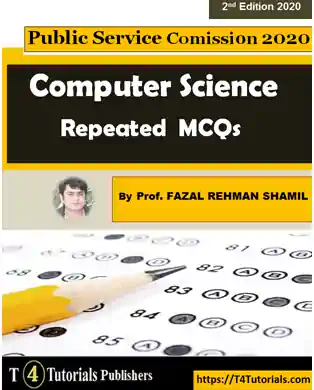
Computer Science Repeated MCQs Book Download

MCQs collection of solved and repeated MCQs with answers for the preparation of competitive exams, admission test and job of PPSC, FPSC, UPSC, AP, APPSC, APSC, BPSC, PSC, GOA, GPSC, HPSC, HP, JKPSC, JPSC, KPSC, KERALAPSC, MPPSC, MPSC, MPSCMANIPUR, MPSC, NPSC, OPSC, RPSC, SPSCSKM, TNPSC, TSPSC, TPSC, UPPSC, UKPSC, SPSC, KPPSC, BPSC, AJKPSC ALPSC, NPSC, LPSC, SCPSC, DPSC, DCPSC, PSC, UPSC, WVPSC, PSCW, and WPSC.

Leave a Reply

Contents Copyrights Reserved By T4Tutorials