
Summary:
Mansfield Park is a novel by Jane Austen, published in 1814. It follows the life of Fanny Price, a poor young girl who is sent to live with her wealthy relatives, the Bertrams, at Mansfield Park. Despite being treated as an inferior by most of the family, she grows up under the care of her kind cousin, Edmund Bertram.
Fanny is intelligent, morally upright, and reserved, often overshadowed by her wealthier and more outgoing cousins, Maria and Julia. The arrival of the charming and sophisticated Henry and Mary Crawford disrupts the peaceful life at Mansfield Park. Henry flirts with both Maria (who is engaged) and Julia, while Mary develops a close relationship with Edmund, hoping to change his career aspirations as a clergyman.
Fanny, who secretly loves Edmund, disapproves of the Crawfords’ manipulative behavior. When Henry proposes to her, she refuses, despite immense pressure from her family. Eventually, Henry elopes with Maria, causing a scandal. Edmund realizes that Mary values wealth and status over morality and breaks off their relationship.
In the end, Fanny is acknowledged for her virtues, and she marries Edmund, while the rest of the family faces the consequences of their actions. The novel explores themes of morality, social class, and the contrast between true virtue and superficial charm.
Score: 0
Attempted: 0/15
Subscribe
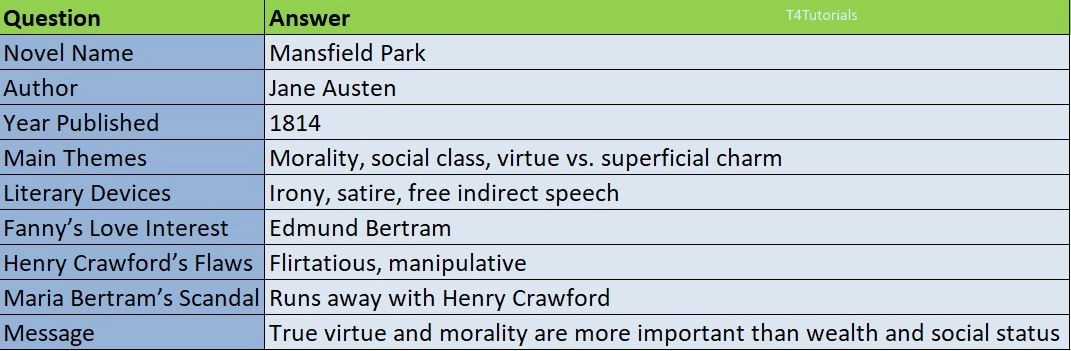
| Question | Answer |
| Novel Name | Mansfield Park |
| Author | Jane Austen |
| Year Published | 1814 |
| Main Themes | Morality, social class, virtue vs. superficial charm |
| Literary Devices | Irony, satire, free indirect speech |
| Fanny’s Love Interest | Edmund Bertram |
| Henry Crawford’s Flaws | Flirtatious, manipulative |
| Maria Bertram’s Scandal | Runs away with Henry Crawford |
| Message | True virtue and morality are more important than wealth and social status |