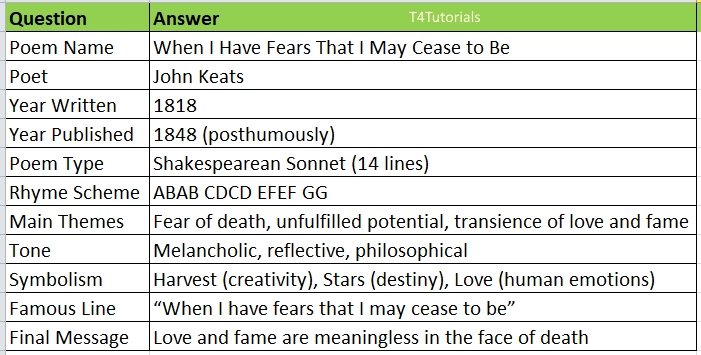
Summary:
“The Eve of St. Agnes”, written by John Keats, is a narrative poem that blends romance, superstition, and medieval imagery. The poem is set on the eve of St. Agnes, a night when, according to folklore, a young maiden can see her future husband in her dreams if she follows certain rituals. The story follows Madeline, a young noblewoman, who believes in the legend and prepares for the vision of her true love. Porphyro, her lover from a rival family, secretly enters her chamber with the help of Angela, an old nurse. As Madeline sleeps, she dreams of Porphyro, and when she wakes, she finds him by her side. He convinces her to escape with him, and they flee together into the stormy night. The poem contrasts the warmth of love with the cold, harsh reality of the outside world, reflecting themes of passion, fate, and the transient nature of dreams.
| Question | Answer |
| Poem Name | The Eve of St. Agnes |
| Poet | John Keats |
| Year Written | 1819 |
| Year Published | 1820 |
| Poem Type | Narrative poem |
| Rhyme Scheme | Spenserian stanza (ABABBCBCC) |
| Main Themes | Love, dreams vs. reality, superstition, fate |
| Tone | Mysterious, romantic, melancholic |
| Symbolism | Storm (danger and uncertainty), Warmth (love and passion), Cold (harsh reality) |
| Famous Line | “St. Agnes’ Eve—Ah, bitter chill it was!” |
| Unique Feature | Inspired by medieval legends and gothic romance |
| Final Message | Love and dreams may be fleeting, but they offer an escape from harsh reality |
1. : Who wrote The Eve of St. Agnes?
(A) Lord Byron
(B) Percy Bysshe Shelley
(C) John Keats
(D) William Wordsworth
2. : What is the main theme of the poem?
(A) Political revolution
(B) Superstition and romance
(C) Nature and its beauty
(D) Friendship and loyalty
3. : What is the significance of St. Agnes’ Eve in the poem?
(A) It is a night for casting spells
(B) It is believed that young women will dream of their future husbands
(C) It marks the beginning of winter
(D) It is a time for religious fasting
4. : Who helps Porphyro enter Madeline’s chamber?
(A) Her father
(B) A knight
(C) Angela, an old nurse
(D) A priest
5. : How does Madeline see Porphyro in her dream?
(A) As a knight in shining armor
(B) As a divine angel
(C) As her future husband
(D) As a ghostly figure
6. : What does the storm at the end of the poem symbolize?
(A) The danger of their escape
(B) The destruction of the castle
(C) The anger of Madeline’s family
(D) A test of their love
7. : What is the setting of the poem?
(A) A rural village
(B) A medieval castle
(C) A forest temple
(D) A deserted island
8. : What literary technique is frequently used in The Eve of St. Agnes?
(A) Satire
(B) Personification
(C) Symbolism
(D) Irony
9. : What is the tone of the poem?
(A) Joyful and celebratory
(B) Mysterious and romantic
(C) Humorous and lighthearted
(D) Tragic and sorrowful
10. : What happens to Porphyro and Madeline at the end of the poem?
(A) They are caught and punished
(B) They vanish into the storm
(C) They return to the castle
(D) They are married the next day