1. The Age of Johnson covers the period:
(A) 1745-1798
(B) 1760-1770
(C) 1750-1790
(D) 1745-1802
2. According to Dr. Johnson “Paradise Lost is one of the books which the reader admires and lays down, and forgets to take up again.” Why according to Johnson?
(A) Because no reader has so much patience.
(B) Because its language is very difficult.
(C) Because its perusal is a hard duty
(D) Because there is want of human interest in it.
3. Dr. Johnson’s prose-style is highly ____.
(A) Obscure
(B) Idiomatic
(C) Simple
(D) Latinised
4. “The Lives of the English Poets is the richest, most beautiful, and indeed most perfect production of Johnson’s pen.” Who has that opinion?
(A) Joshua Reynolds
(B) Boswell
(C) Gibbon
(D) Burke
5. On what grounds does Johnson defend Shakespeare’s violation of Unities in his plays?
(A) The observation of the Unities is not possible on the stage
(B) Strict observation of the Unities spoil the dramatic effect
(C) Strict observation of the three Unities is not possible in real life
(D) The observation of the Unities is artificial
6. “Shakespeare’s plays are neither pure Tragedies nor pure Comedies,” Which is the exact meaning of Johnson by this observation?
(A) Art is not meant to preach any philosophy of life.
(B) Real life is not entirely tragic.
(C) Real life is not entirely comic.
(D) Shakespeare’s plays are true copies of real life.
7. Johnson’s Rambler is still relevant because the Papers published in it _____.
(A) Contains Johnson’s principles of criticism
(B) Give a true picture of eighteenth century life
(C) Brief and interesting
(D) Non-Controversial
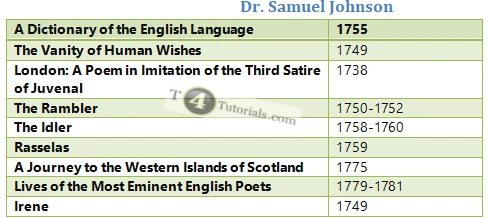
8. In 1749 Dr Samuel Johnson published Irene as a _____.
(A) A long poem
(B) A tragedy
(C) A comedy
(D) A long satire
9. Who is the writer of Johnson’s famous Biography?
(A) Goldsmith
(B) Boswell
(C) Joshua Reynolds
(D) Gibbon
10. Dr Johnson whole-heartedly belonged to which literary School?
(A) Romantic School
(B) Victorian School
(C) Augustan School
(D) Restoration School
11. Dr. Johnson’s The Vanity of Human Wishes was written in:
(A) Blank Verse
(B) Hexameter Couplets
(C) Free Verse
(D) Heroic Couplets
12. Dr. Johnson’s most ambitious work was A Dictionary of the English Language. How many years did he take in finishing it?
(A) Nine years from 1746-55
(B) Seven years from 1748-55
(C) Eight years from 1747-55
(D) None of these
13. Another equally ambitious work of Dr Johnson was Lives of the Most Eminent English Poets. The Lives of how many poets were written by him?
(A) 50
(B) 54
(C) 52
(D) 55
14. According to Johnson, why did Milton write The Paradise Lost in Blank Verse?
(A) Because Milton had no musical sense.
(B) Because Milton could not write in rhyming verse
(C) Because it is easier to write in Blank verse than in rhyming verse.
(D) Because Blank verse was in vogue in Milton’s times.
15. “In this poem there is no nature, for there is no truth; there is no art, for there is nothing new.” About which poem does Johnson hold this view?
(A) L’Allegro
(B) Lycidas
(C) Il Penseroso
(D) Comus
16. What is Milton’s Comus?
(A) A Masque
(B) A sonnet
(C) An allegorical poem
(D) A Pamphlet
17. Dr. Johnson was a great force to continue:
(A) The Romantic Tradition
(B) The Elizabethan Tradition
(C) The Augustan Tradition
(D) The Restoration Tradition
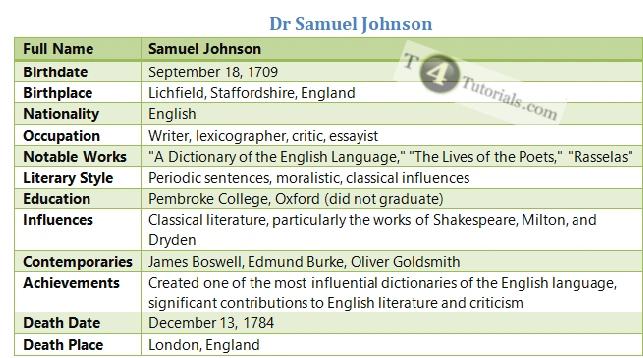
18. Dr. Johnson was born in which year?
(A) 1708
(B) 1711
(C) 1710
(D) 1709
19. What was the name of the Periodical which Johnson started in imitation of the Spectator?
(A) The Awakener
(B) The Grumbler
(C) The Rambler
(D) The Morning Star