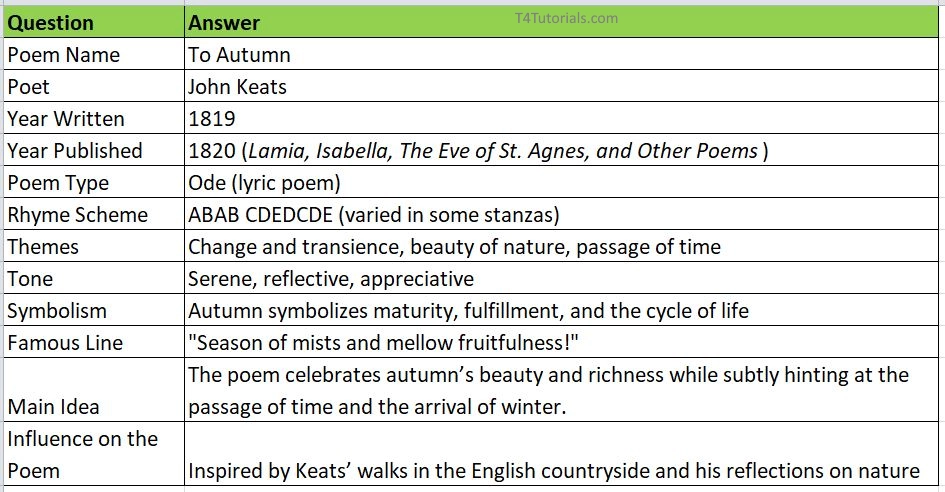
Summary:
John Keats’ Ode on Melancholy is a deeply reflective poem that explores the nature of sadness and how it is intricately linked to beauty and joy. Unlike his other odes, this one does not create a mythical or distant world but directly addresses human emotions. Keats suggests that melancholy should not be avoided but embraced, as it enhances the appreciation of beauty and happiness. The poem consists of three stanzas, each offering guidance on how to experience melancholy without being consumed by it. He advises against seeking oblivion in death or artificial pleasures, instead urging one to immerse in the beauty of life, as all joy is fleeting. This transient nature of happiness makes it all the more precious.
| Question | Answer |
| Poem Name | Ode on Melancholy |
| Poet | John Keats |
| Year Written | 1819 |
| Year Published | 1820 (Lamia, Isabella, The Eve of St. Agnes, and Other Poems) |
| Poem Type | Ode (lyric poem) |
| Rhyme Scheme | ABABCDECDE (in each stanza) |
| Themes | The connection between joy and sorrow, the fleeting nature of happiness, emotional depth |
| Tone | Philosophical, reflective, intense |
| Symbolism | Beauty represents fleeting joy, melancholy represents emotional depth, nature reflects human emotions |
| Famous Line | “She dwells with Beauty—Beauty that must die;” |
| Main Idea | Keats argues that melancholy is not to be escaped but experienced fully, as it deepens our appreciation of beauty and joy. |
| Unique Feature of the Poem | Unlike Keats’ other odes, it does not create an imaginary or mythical world but speaks directly to human emotions. |
| Influence on the Poem | Inspired by Keats’ observations on the fleeting nature of happiness and his own struggles with illness and mortality. |
1. : Who wrote the poem Ode on Melancholy?
(A) William Wordsworth
(B) John Keats
(C) Percy Bysshe Shelley
(D) Lord Byron
2. : In which year was Ode on Melancholy written?
(A) 1817
(B) 1818
(C) 1819
(D) 1820
3. : When was the poem published?
(A) 1819
(B) 1820
(C) 1821
(D) 1825
4. : What is the central theme of the poem?
(A) The pain of unrequited love
(B) The connection between joy and sorrow
(C) The struggle between life and death
(D) The power of nature over humans
5. : How many stanzas are in Ode on Melancholy?
(A) Two
(B) Three
(C) Four
(D) Five
6. : What does Keats warn against in the first stanza?
(A) Ignoring beauty
(B) Seeking escape in death or oblivion
(C) Falling in love too quickly
(D) Trusting false friends
7. : What famous line appears in the poem?
(A) “She dwells with Beauty—Beauty that must die;”
(B) “A thing of beauty is a joy forever.”
(C) “O Attic shape! Fair attitude!”
(D) “Season of mists and mellow fruitfulness!”
8. : What does Keats suggest is the best way to experience melancholy?
(A) By ignoring it completely
(B) By surrendering to sadness
(C) By embracing beauty and understanding its fleeting nature
(D) By seeking revenge against those who cause sorrow
9. : What does Keats compare melancholy to?
(A) A stormy sea
(B) A goddess who resides with beauty and joy
(C) A fierce warrior
(D) A dark shadow that never leaves
10. : How is Ode on Melancholy different from Keats’ other odes?
(A) It has a cheerful and celebratory tone
(B) It speaks directly to human emotions rather than using mythology
(C) It is written in free verse rather than rhyme
(D) It focuses entirely on historical events