
1. “He was as fresh as the month of May.” This line is part of the Prologue. This line refers to _______ .
(A) Squire
(B) Franklin
(C) Doctor of Physic
(D) None of these
2. Which work is not a work of Chaucer?
(A) The House of Fame
(B) The Legend of Good Women
(C) The Owl and the Nightingale
(D) Romaunt of the Rose
3. Which is Chaucer’s prose work?
(A) Treatise on the Astrolabe
(B) The Legend of Good Women
(C) Troylus and Cryseyde
(D) The House of Fame
4. Who is the writer of a famous poem mourning the death of Chaucer?
(A) William Dunwar in The Thistle and the Rose
(B) Lydgate in Falles of Princes
(C) James I of Scotland in The King’s Quair
(D) Occleve in The Governail of Princes
5. Which was the closest contemporary of Chaucer?
(A) John Gower
(B) Wyclif
(C) William Langland
(D) John Barbour
6. ____ called Chaucer “the Father of English Poetry”?
(A) Dryden
(B) Spenser
(C) Sidney
(D) Arnold
7. ______ says about Chaucer’s ‘Characters-“Here is God’s Plenty.”
(A) Dr. Johnson
(B) Dryden
(C) Pope
(D) Coleridge
8. In which month did Chaucer’s pilgrims go on their pilgrimage?
(A) January
(B) April
(C) March
(D) February
9. How many pilgrims in Chaucer’s Canterbury Tales are going on the pilgrimage?
(A) 27
(B) 40
(C) 30
(D) 29
10. How many pilgrims in the Prologue to the Canterbury Tales represent the knighthood class?
(A) One
(B) Two
(C) Seven
(D) Three
11. One of the portraits in the Prologue is that of the Wife of Bath. What is Bath?
(A) The Christian name of the lady
(B) The name of the town to which she belonged
(C) The name of her husband
(D) The surname of the lady
12. It is believed that the Host at the Inn was a real man. Who is the Host?
(A) Henry Bailly
(B) Hoary Bailly
(C) Horney Bailly
(D) Harry Bailly
13. What is the name of the Inn where the pilgrims assemble for the night?
(A) Southwark Inn
(B) Temple Inn
(C) St. Becket Inn
(D) Tabard Inn
14. To which shrine are the pilgrims going?
(A) Shrine of St. Thomas a’ Becket at Canterbury
(B) Shrine of St. Lucas at Jerusalem
(C) Shrine of St. Agnes at Canterbury
(D) Shrine of St. Mark in Southwark
15. One of the Tales in Chaucer’s Canterbury Tales is in prose.
(A) The Pardoner’s Tale
(B) The Knight’s Tale
(C) The Monk’s Tale
(D) The Parson’s Tale
16. Chaucer was not indebted for his sources to one of the following, Identify him:
(A) Dante
(B) Virgil
(C) Homer
(D) Ovid
17. Between which sets of dates did Chaucer live?
(A) 1348-1410
(B) 1329-1330
(C) 1340-1400
(D) 1349-1400
18. Chaucer lived during the reigns of ___.
(A) Edward 3, Richard 2, and Henry 4
(B) Edward 3 and Henry 4
(C) Richard 2 and Henry 4
(D) None of these
19. Who mentioned Chaucer as “The Well of English Undefiled”?
(A) Dryden
(B) Sidney
(C) Pope
(D) Spenser
20. “With Chaucer is born our real poetry.” Who has that opinion?
(A) Addison
(B) Spenser
(C) Dryden
(D) Matthew Arnold
21. “Chaucer found his native tongue a dialect and left it a language.” ______ makes this observation?
(A) I. A. Richards
(B) Lowes
(C) F.R. Leavis
(D) Walter Pater
22. “Chaucer is the earliest of the great moderns.” Who has that opinion?
(A) Dryden
(B) Matthew Arnold
(C) T.S. Eliot
(D) Ben Jonson
23. “If Chaucer is the Father of English Poetry, he is the Grandfather of the English Novel.” Who makes this remark?
(A) GK Chesterton
(B) Ruskin
(C) Walter Pater
(D) Coleridge
24. Total ______ ecclesiastical characters are portrayed in the Prologue?
(A) Three
(B) Eight
(C) Seven
(D) Six
25. How many women characters figure in the Prologue to the Canterbury Tales?
(A) Five
(B) Three
(C) Two
(D) Four
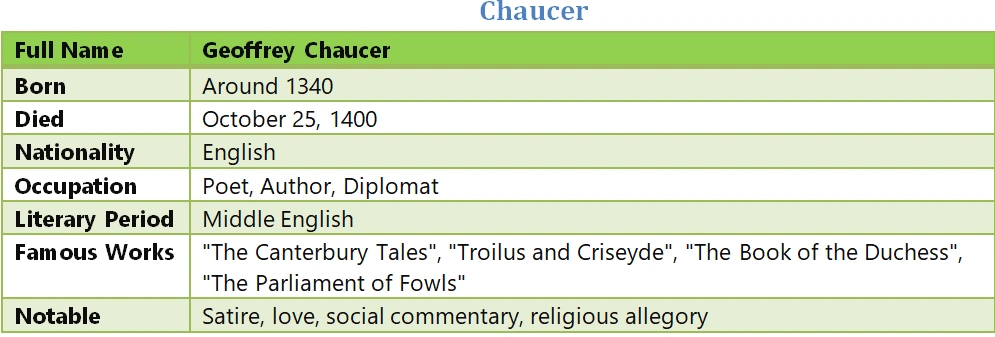
Chaucer basic info
| Full Name | Geoffrey Chaucer |
| Born | Around 1340 |
| Died | October 25, 1400 |
| Nationality | English |
| Occupation | Poet, Author, Diplomat |
| Literary Period | Middle English |
| Famous Works | “The Canterbury Tales”, “Troilus and Criseyde”, “The Book of the Duchess”, “The Parliament of Fowls” |
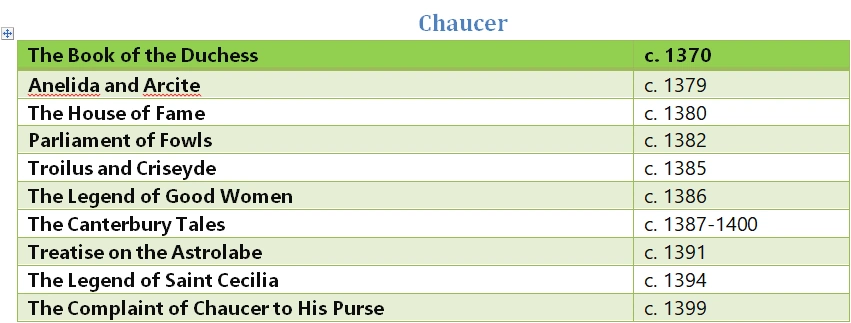
Chaucer books names
| The Book of the Duchess | c. 1370 |
| Anelida and Arcite | c. 1379 |
| The House of Fame | c. 1380 |
| Parliament of Fowls | c. 1382 |
| Troilus and Criseyde | c. 1385 |
| The Legend of Good Women | c. 1386 |
| The Canterbury Tales | c. 1387-1400 |
| Treatise on the Astrolabe | c. 1391 |
| The Legend of Saint Cecilia | c. 1394 |
| The Complaint of Chaucer to His Purse | c. 1399 |
MCQs & Summary of Some Famous poems & books by Geoffrey Chaucer
- The Canterbury Tales MCQs & Summary
- The Knight’s Tale MCQs & Summary
- The Miller’s Tale MCQs & Summary
- The Wife of Bath’s Tale MCQs & Summary
- The Pardoner’s Tale MCQs & Summary
- The Nun’s Priest’s Tale MCQs & Summary
- Troilus and Criseyde MCQs & Summary
- The Parliament of Fowls MCQs & Summary
- The Book of the Duchess MCQs & Summary
- The House of Fame MCQs & Summary
Famous English Authors MCQs
- William Wordsworth MCQs
- William Shakespeare MCQs
- Robert Browning MCQs
- W B Yeats MCQs
- Edmund Spenser MCQs
- Chaucer MCQs
- John Milton MCQs
- S T Coleridge MCQs
- Lord Byron MCQs
- PB Shelley MCQs
- John Dryden MCQs
- John Keats MCQs
- Charles Dicken MCQs
- Alfred Lord Tennyson MCQs
- Charles Lamb MCQs
- D.H Lawrence MCQs
- Thomas Hardy MCQs
- Matthew Arnold MCQs
- John Galsworthy MCQs
- George Bernard Shaw MCQs
- T.S Eliot MCQs
- Ben Jonson MCQs
- Francis Bacon MCQs
- Alexander Pope MCQs
- Oliver Goldsmith MCQs
- Joseph Addison MCQs
- Dr Samuel Johnson MCQs
- Henry Fielding MCQs
- Sir Walter Scott MCQs
- Jane Austen MCQs
- Dr. Samuel Johnson MCQs
- English Comedy MCQs (Oliver Goldsmith)
- Alexander Pope MCQs (Neo-Classical Age of English Poetry)
- Daniel Defoe MCQs
- Dr. Jonathan Swift MCQs
- Richard Steele MCQs
- English Drama MCQs
- Elizabethan Drama MCQs [14th to 17th century]
- Elizabethan Prose MCQs
More English Literature MCQs
- English Poetry MCQs
- History of English Literature MCQs
- Sentimental Novels MCQs
- Sentimental Poetry MCQs
- Legends Of English Literature MCQs
- English Literature Quiz
- English Literature Important Multiple Choice Questions Answers
- Sons And Lovers by D H Lawrence MCQs
- The Waste Land, A Poem by T. S. Eliot MCQs
- Drama Origin MCQs
- History of the Renaissance Period MCQs
- English Pros MCQs
- Non-Dramtic Poets Of The Elizabethan Age MCQs
- The Cavalier Poets of 17th-century MCQs
- Metaphysical Poets of 17th century MCQs
- Renaissance Period of 14th, 15th, and 16th centuries MCQs
- Puritan Poet MCQs
- Restoration Comedy by William Congreve & Wycherley MCQs
- Satire MCQs – Renaissance Period by John Dryden
- English Essayists MCQs
- Romantic Period of Romantic Poets MCQs
- English language MCQs
- English Humour MCQs [American Literature]
- Early Writers of American Literature MCQs
- History of American Literature MCQs
- American Prose MCQs [English Realism ]
- American English Critics
- New Englanders Authors MCQs
- MCQs on American Literature After Independence
- American Playwrights MCQs
- New American Poetry MCQs
- British English Critics MCQs
- Ancient English literature MCQs
- Important English Literature MCQs for Public Service Commission
- English Literature Repeated Important MCQs
- CSS English Literature MCQs
- History of Early Period MCQs
- The Anglo-Saxon period MCQs
- The Age of Chaucer in the Early Period MCQs
- The Anglo-Norman Period of French Writers MCQs
- Metrical Romances MCQ (Anglo-Saxon Period)
- Revival of Learning MCQs (1400-1550)
- Applied Linguistics MCQs
- Language Change MCQs