Summary:
“Ode to a Nightingale” is one of John Keats’ most famous odes, written in 1819. The poem explores themes of mortality, the transient nature of human life, and the contrast between the fleeting joys of reality and the timeless beauty of art. Inspired by the song of a nightingale, Keats expresses a deep yearning to escape the pains of the world and join the bird in its eternal melody. He considers various means of escape, such as wine and poetry, but ultimately realizes that death is not the answer. The poem concludes with uncertainty, as the speaker questions whether his experience was real or just a dream.
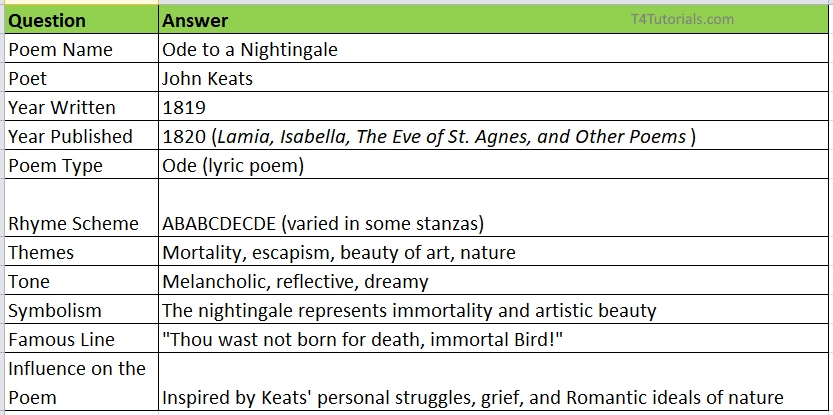
| Question | Answer |
| Poem Name | Ode to a Nightingale |
| Poet | John Keats |
| Year Written | 1819 |
| Year Published | 1820 (Lamia, Isabella, The Eve of St. Agnes, and Other Poems) |
| Poem Type | Ode (lyric poem) |
| Rhyme Scheme | ABABCDECDE (varied in some stanzas) |
| Themes | Mortality, escapism, beauty of art, nature |
| Tone | Melancholic, reflective, dreamy |
| Symbolism | The nightingale represents immortality and artistic beauty |
| Famous Line | “Thou wast not born for death, immortal Bird!” |
| Influence on the Poem | Inspired by Keats’ personal struggles, grief, and Romantic ideals of nature |
1. : Who wrote Ode to a Nightingale?
(A) William Wordsworth
(B) John Keats
(C) Samuel Taylor Coleridge
(D) Percy Bysshe Shelley
2. : When was Ode to a Nightingale written?
(A) 1815
(B) 1817
(C) 1819
(D) 1821
3. : What is the central theme of Ode to a Nightingale?
(A) The beauty of the industrial revolution
(B) The contrast between human suffering and the nightingale’s eternal song
(C) The importance of education
(D) The power of political movements
4. : In which year was the poem published?
(A) 1818
(B) 1819
(C) 1820
(D) 1822
5. : Which poetic form does Ode to a Nightingale follow?
(A) Sonnet
(B) Ballad
(C) Lyric
(D) Ode
6. : What does the nightingale symbolize in the poem?
(A) Death and destruction
(B) Immortality and artistic beauty
(C) The fleeting nature of love
(D) The struggles of a poet
7. : What type of escape does Keats long for in the poem?
(A) Travel to foreign lands
(B) Escape through wine, poetry, and death
(C) Escape through war and conquest
(D) Escape through wealth and luxury
8. : What is the tone of the poem?
(A) Joyful and celebratory
(B) Angry and rebellious
(C) Melancholic and reflective
(D) Sarcastic and humorous
9. : What famous line from the poem expresses the idea that the nightingale is eternal?
(A) “A thing of beauty is a joy forever.”
(B) “Beauty is truth, truth beauty.”
(C) “Thou wast not born for death, immortal Bird!”
(D) “Season of mists and mellow fruitfulness.”
10. : What ultimately prevents the poet from fully escaping into the world of the nightingale?
(A) His physical weakness
(B) His realization that death is not the answer
(C) A sudden storm that disrupts his thoughts
(D) The nightingale flying away