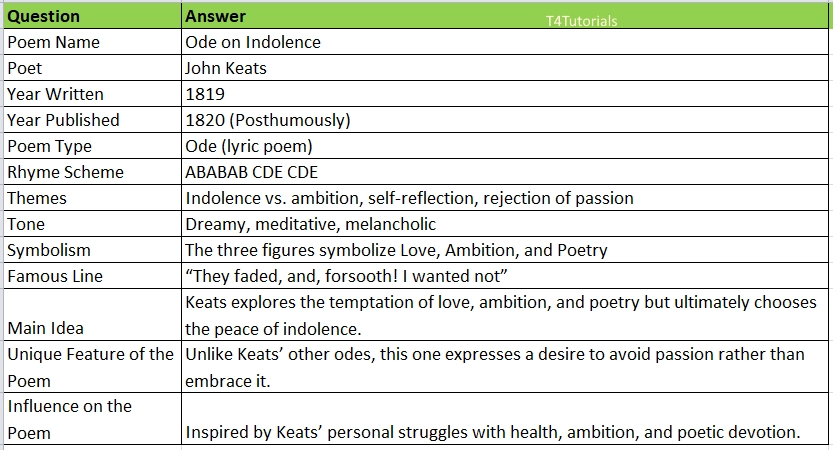
Summary:
John Keats’ Ode on Indolence explores the poet’s struggle between ambition and relaxation. The poem begins with a dreamlike vision where three ghostly figures—Love, Ambition, and Poetry—pass before the poet like images on an ancient urn. At first, he is tempted to follow them, but he ultimately chooses to remain in his state of indolence (laziness), rejecting worldly desires and the burdens of passion. The poem reflects Keats’ inner conflict about whether to engage in life’s pursuits or stay in a peaceful, detached state. The tone is meditative and melancholic, highlighting the fleeting nature of ambition and desire.
| Question | Answer |
| Poem Name | Ode on Indolence |
| Poet | John Keats |
| Year Written | 1819 |
| Year Published | 1820 (Posthumously) |
| Poem Type | Ode (lyric poem) |
| Rhyme Scheme | ABABAB CDE CDE |
| Themes | Indolence vs. ambition, self-reflection, rejection of passion |
| Tone | Dreamy, meditative, melancholic |
| Symbolism | The three figures symbolize Love, Ambition, and Poetry |
| Famous Line | “They faded, and, forsooth! I wanted not” |
| Main Idea | Keats explores the temptation of love, ambition, and poetry but ultimately chooses the peace of indolence. |
| Unique Feature of the Poem | Unlike Keats’ other odes, this one expresses a desire to avoid passion rather than embrace it. |
| Influence on the Poem | Inspired by Keats’ personal struggles with health, ambition, and poetic devotion. |
1. : What is the central theme of Ode on Indolence?
(A) The power of imagination
(B) The conflict between ambition and relaxation
(C) The beauty of nature
(D) The passage of time
2. : How many figures appear in Keats’ vision?
(A) Two
(B) Three
(C) Four
(D) Five
3. : Which three figures appear in the poem?
(A) Love, Ambition, and Poetry
(B) Time, Fate, and Death
(C) Beauty, Truth, and Joy
(D) Night, Day, and Memory
4. : How does Keats feel about the three figures at the end of the poem?
(A) He asks them to stay forever
(B) He chooses to let them go
(C) He tries to capture them in poetry
(D) He follows them eagerly
5. : What poetic form is Ode on Indolence written in?
(A) Sonnet
(B) Elegy
(C) Ode
(D) Ballad
6. : What is the rhyme scheme of the poem?
(A) ABAB CDE CDE
(B) ABABAB CDE CDE
(C) AABBCC DDEEFF
(D) ABCABC DEFDEF
7. : What does Keats compare the figures to in the poem?
(A) Shadows in the night
(B) Figures on an urn
(C) Birds in the sky
(D) Waves in the ocean
8. : What is the tone of the poem?
(A) Joyful and uplifting
(B) Dreamy and melancholic
(C) Angry and critical
(D) Philosophical and hopeful
9. : What inspired Ode on Indolence?
(A) A personal dream or vision
(B) A historical event
(C) A Greek myth
(D) A political issue
10. : What does Keats ultimately choose at the end of the poem?
(A) To follow Love
(B) To embrace Ambition
(C) To remain in indolence
(D) To devote himself to Poetry