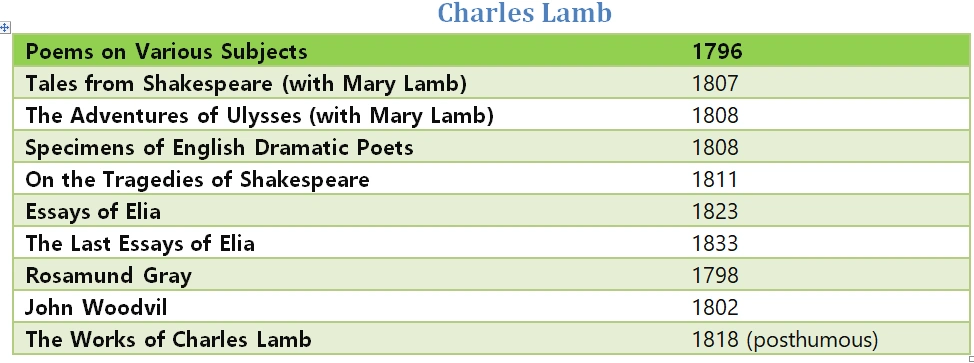
1. Wherein were Lamb’s essays first published serially?
(A) In the Quarterly Review
(B) In the London Magazine
(C) In the Edinburgh Review
(D) In Blackwood’s Magazine
2. Which essay of Lamb is most pathetic?
(A) Dream-Children
(B) Recollections of Christ’s Hospital
(C) Grace Before Meat
(D) In Praise of Chimney-Sweepers
3. Who was Elia, under whose name Lamb published his essays?
(A) Lamb’s elder brother
(B) Lamb’s colleague in Christ’s Hospital
(C) Lamb’s colleague working with him in The East India House
(D) Just an imaginary name
4. How did Lamb’s mother die?
(A) She was killed by Lamb’s mad sister
(B) She committed suicide
(C) She was drowned in the Thames
(D) She was killed in an accident
5. “It is the man Charles Lamb that constitutes the charm of his written words.” Who says this?
(A) Saintsbury
(B) Canon Ainger
(C) De Quincey
(D) Hugh Walker
6. Lamb wrote Tales from Shakespeare in collaboration with which of the following?
(A) Mary Lamb
(B) William Cobbett
(C) Hazlitt
(D) Leigh Hunt
7. One of the following essays is not created and written by Lamb. Which one?
(A) Imperfect Sympathies
(B) Old China
(C) Modern Gallantry
(D) My School and School Masters
8. What is Lamb’s Prince Dorus?
(A) A Comedy
(B) A tale in prose
(C) A narrative poem
(D) A fairy tale in verse
9. In which essay does Lamb make an indirect allusion to his frustration in love?
(A) Poor Relations
(B) Bachelor’s Complaint
(C) Recollections of Christ’s Hospital
(D) Dream-Children
10. Who says Lamb is “One of the best beloved of English authors”?
(A) Hugh Walker
(B) Saintsbury
(C) W.H. Hudson
(D) George Sampson
11. Which essay of Lamb is most autobiographical?
(A) Bachelor’s Complaint against Married Men
(B) Poor Relations
(C) Old China
(D) Imperfect Sympathies
12. Charles Lamb is best famous for his:
(A) John Woodvil, a Tragedy
(B) Tales from Shakespeare
(C) Poems for Children
(D) Essays of Elia
13. One of the following essays is written by Lamb. Which one?
(A) Indian Jugglers
(B) The English Mail-Coach
(C) On Saying ‘Please’
(D) Christ’s Hospital
14. “The children of Alice call Bartrum father.” This sentence is part of Lamb’s essay Dream-Children. Who was Bartrum?
(A) A close relative of Lamb
(B) Lamb’s colleague in East India House
(C) The man who married the woman whom Lamb loved
(D) Lamb’s elder brother
15. Lamb suffered from a hereditary disease for some time. What was that disease?
(A) A streak of madness
(B) Consumption
(C) Asthma
(D) Melancholia
16. Lamb began his career as _______.
(A) An Assistant Editor in the London Magazine
(B) A clerk in Christ’s Hospital
(C) A clerk in East India House
(D) A freelance journalist
17. Lamb did not marry because:
(A) He did not like the system of marriage
(B) He was too poor to maintain a family
(C) He did not want to curtail his personal freedom
(D) He had to maintain his mad sister
18. Lamb loved a woman whom, however, he could not marry. What was her name?
(A) Mary Winterton
(B) Alice Browne
(C) Ann Simmons
(D) Alice White
19. Charles Lamb wrote his essays under the pen-name:
(A) Ilia
(B) Ellia
(C) Elia
(D) Alia
20. Lamb once said, “I am myself the subject of my essay.” What did he mean by this?
(A) That the style of writing his essays is his own
(B) That his essays are largely autobiographical
(C) That he did not borrow the subject of his essays from anywhere
(D) That he wrote his essays on the subjects around him
21. It is said that Lamb smiled with one eye and wept with the other. What does it mean?
(A) That he had some eye problem by birth
(B) That he saw great ups and downs in life
(C) That there was a blending of humour and pathos in his essays
(D) That he could not get so much fame in his literary career as he wanted to get
22. Lamb’s memory “will retain its fragrance as long as the best spice expended on the Pharaohs.” Who said this?
(A) Robert Southey
(B) Wordsworth
(C) Coleridge
(D) Hazlitt
23. What is Lamb’s John Woodvil?
(A) A satirical play
(B) A comic play
(C) A tragic play
(D) A fairy-play for children
24. ____ called Lamb “gentle-hearted Charles”?
(A) Leigh Hunt
(B) Hazlitt
(C) De Quincey
(D) Coleridge