1. T.S. Eliot calls “Byron so empty of matter, Shelley so incoherent, and Wordsworth so wanting in completeness and variety.” Where does he say so?
(A) In the Preface to The Sacred Wood
(B) In the Introduction to The Sacred Wood
(C) In Tradition and the Individual Talent
(D) In The Perfect Critic
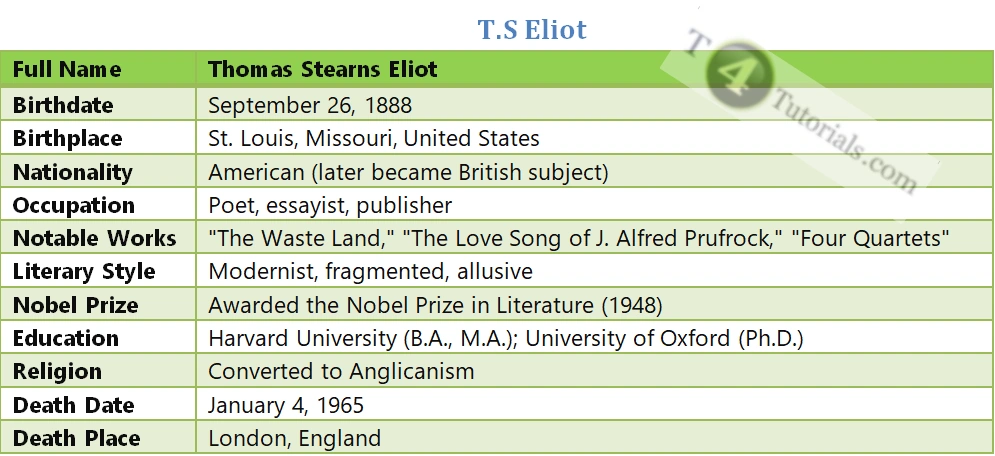
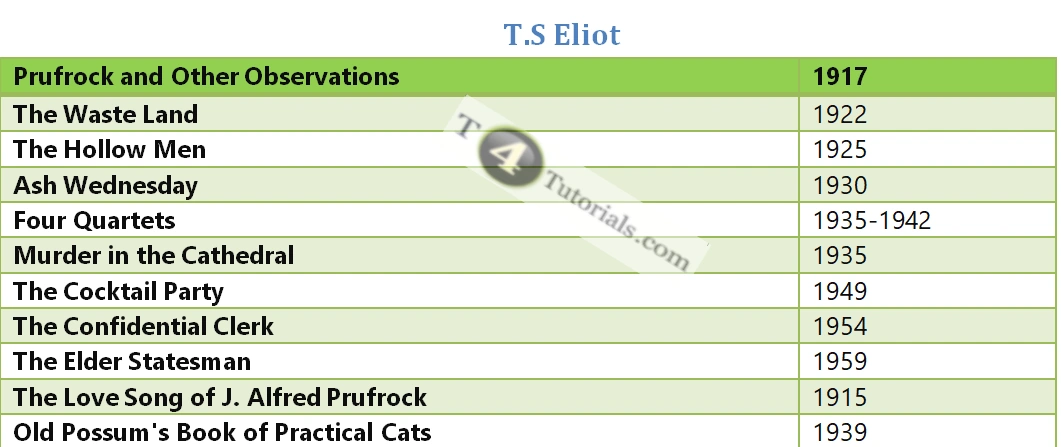
2. To whom did T.S. Eliot dedicate The Waste Land?
(A) John Ruskin
(B) Bernard Shaw
(C) Rudyard Kipling
(D) Ezra Pound
3. To whom did T.S. Eliot dedicate Prufrock and Other Observations?
(A) W.B. Yeats
(B) Ezra Pound
(C) Jean Verdenal
(D) F.R. Leavis
4. In which type of verse-form is the play The Family Reunion written?
(A) Blank Verse
(B) Free Verse
(C) Sprung Rhythm
(D) Prose-Verse
5. According to T.S. Eliot, “No poet, no artist of any art, has his complete meaning alone.” Why?
(A) Because he is a part of society
(B) Because no man is complete in himself
(C) Because he is connected with a tradition from which he cannot break away
(D) Because a work of art must be universal
6. According to T.S. Eliot, “Poetry is not a turning loose of emotion, but an escape from emotion…” Where does Eliot make this observation?
(A) In The Perfect Critic
(B) In Imperfect Critic
(C) In Tradition and the Individual Talent
(D) In The Possibility of a Poetic Drama
7. In which verse-form is T.S. Eliot’s The Waste Land written?
(A) Free Verse
(B) Blank Verse
(C) Sprung Rhythm
(D) Prose-Verse
8. T.S. Eliot has not written a critical article on one of the following. Locate him:
(A) Blake
(B) Dante
(C) Swinburne
(D) Shelley
9. Which play of Shakespeare has been regarded as “One of Shakespeare’s most assured artistic successes” by T.S. Eliot?
(A) Coriolanus
(B) Hamlet
(C) The Tempest
(D) The Comedy of Errors
10. What is, according to T.S. Eliot, the most powerful tool in the hands of a critic?
(A) Evaluation of the central thought of the work under review
(B) Comparison and analysis
(C) Language and style of the author under review
(D) Evaluation of the structural unity of the work under review
11. T.S. Eliot calls Arnold “a propagandist of literature, and an over-worked school inspector.” Where does he make this observation?
(A) In The Perfect Critic
(B) In Imperfect Critic
(C) In A Romantic Aristocrat
(D) In The Local Flavour
12. Which poem ends with the following lines?
“Datta, Dayadhvam, Damyata, Shanti, Shanti, Shanti.”
(A) The Hollow Men
(B) Ash-Wednesday
(C) The Waste Land
13. The Sacred Wood is:
(A) A Collection of poems
(B) A poetic play
(C) A Collection of Critical articles
(D) A Classical drama
14. Which of Shakespeare’s plays is critically referenced by Eliot?
(A) Cymbeline
(B) The Tempest
(C) Antony and Cleopatra
(D) Romeo and Juliet
15. The following lines are taken from which poem?
“When lovely woman stoops to folly…”
(A) The Burial of the Dead
(B) What the Thunder Said
(C) The Fire Sermon
16. Which of Eliot’s poems ends with these lines:
“This is the way the world ends, Not with a bang but a whimper.”
(A) The Hollow Men
(B) Ash-Wednesday
(C) A Song for Simeon
17. Into how many parts is The Waste Land divided?
(A) Two Parts
(B) Three Parts
(C) Four Parts
(D) Five Parts
18. Which poem begins with:
“Because I do not hope to turn again…”
(A) The Hollow Men
(B) Mr. Eliot’s Sunday Morning Service
(C) Ash-Wednesday
19. On what basis does Eliot call Hamlet an artistic failure?
(A) Because Hamlet broods too much
(B) Because Hamlet feigns madness
(C) Because the plot is disjointed
(D) Because Hamlet lacks in objective correlative
20. What type of play is Murder in the Cathedral?
(A) A stage play written for Canterbury
(B) A Romantic tragedy
(C) A Literary play
(D) A Revenge play
21. “…….is the most carefully worked, and the most deeply flawed of all Eliot’s plays.” Which play is referred to?
(A) Murder in the Cathedral
(B) The Family Reunion
(C) The Cocktail Party
(D) The Confidential Clerk
22. What is Eliot’s The Cocktail Party?
(A) A collection of essays
(B) A drama
(C) A collection of poems
(D) A critical work
23. T.S. Eliot’s line “Sweet Thames, run softly till I end my song” is quoted from a poem by:
(A) Shakespeare
(B) Donne
(C) Wordsworth
(D) Spenser
24. The phrase “dissociation of sensibility” was used by Eliot in:
(A) Tradition and the Individual Talent
(B) The Metaphysical Poets
(C) Dante
(D) Baudelaire
25. “I have measured out my life with coffee spoons.” This line is from:
(A) The Love Song of J. Alfred Prufrock
(B) Gerontion
(C) Sweeney Erect
(D) The Burial of the Dead
26. “No! I am not Prince Hamlet, nor was meant to be.” This line is from:
(A) The Love Song of J. Alfred Prufrock
(B) A Cooking Egg
(C) Gerontion
(D) Portrait of a Lady
27. T.S. Eliot uses the term “Objective Correlative” in:
(A) The Function of Criticism
(B) Tradition and the Individual Talent
(C) The Frontiers of Criticism
(D) Hamlet and His Problems
28. What is Eliot’s The Confidential Clerk?
(A) A Play
(B) A Novel
(C) A Long Narrative Poem
(D) A Critical Treatise
29. How many parts are there in Eliot’s play The Family Reunion?
(A) Two Parts
(B) Three Parts
(C) Four Parts
(D) Five Parts
30. The Waste Land is a series of how many poems?
(A) Three Poems
(B) Four Poems
(C) Five Poems
(D) Six Poems