Summary:
“Isabella, or the Pot of Basil” is a narrative poem by John Keats, based on a story from Decameron by Giovanni Boccaccio. The poem tells the tragic love story of Isabella, a young woman from a wealthy merchant family, and Lorenzo, a poor worker employed by her brothers. Isabella’s brothers disapprove of their love and murder Lorenzo to protect their family’s wealth. Isabella discovers Lorenzo’s fate through a vision, finds his buried body, and cuts off his head, placing it in a pot of basil, which she waters with her tears. Her grief consumes her, and when her brothers take away the pot, she dies heartbroken
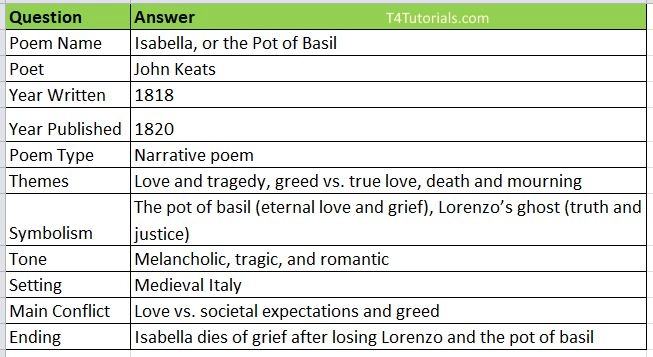
| Question | Answer |
| Poem Name | Isabella, or the Pot of Basil |
| Poet | John Keats |
| Year Written | 1818 |
| Year Published | 1820 |
| Poem Type | Narrative poem |
| Themes | Love and tragedy, greed vs. true love, death and mourning |
| Symbolism | The pot of basil (eternal love and grief), Lorenzo’s ghost (truth and justice) |
| Tone | Melancholic, tragic, and romantic |
| Setting | Medieval Italy |
| Main Conflict | Love vs. societal expectations and greed |
| Ending | Isabella dies of grief after losing Lorenzo and the pot of basil |
1. : Who is Isabella in love with?
(A) A knight
(B) A king
(C) Lorenzo
(D) A nobleman
2. : Why do Isabella’s brothers kill Lorenzo?
(A) They dislike him personally
(B) They want Isabella to marry a rich man
(C) Lorenzo tries to steal their money
(D) Lorenzo insults them
3. : How does Isabella find out about Lorenzo’s murder?
(A) A letter from Lorenzo
(B) A dream/vision
(C) A witness tells her
(D) Her brothers confess
4. : What does Isabella do with Lorenzo’s body?
(A) Burns it
(B) Buries it in a church
(C) Cuts off his head and places it in a pot of basil
(D) Leaves it in the forest
5. : What happens to Isabella’s pot of basil?
(A) It is stolen by her brothers
(B) It grows into a tree
(C) It is blessed by a priest
(D) It is given to Lorenzo’s family
6. : What ultimately happens to Isabella?
(A) She marries someone else
(B) She leaves the city
(C) She dies of grief
(D) She becomes a nun
7. : What is the main theme of the poem?
(A) The importance of family honor
(B) The conflict between love and greed
(C) The dangers of ambition
(D) The power of fate
8. : Which literary device is heavily used in the poem?
(A) Satire
(B) Symbolism
(C) Irony
(D) Allegory
9. : What does the pot of basil symbolize?
(A) Isabella’s wealth
(B) The passage of time
(C) Eternal love and grief
(D) Revenge
10. : What literary work inspired Keats’ Isabella, or the Pot of Basil?
(A) The Canterbury Tales
(B) The Decameron
(C) Paradise Lost
(D) The Divine Comedy