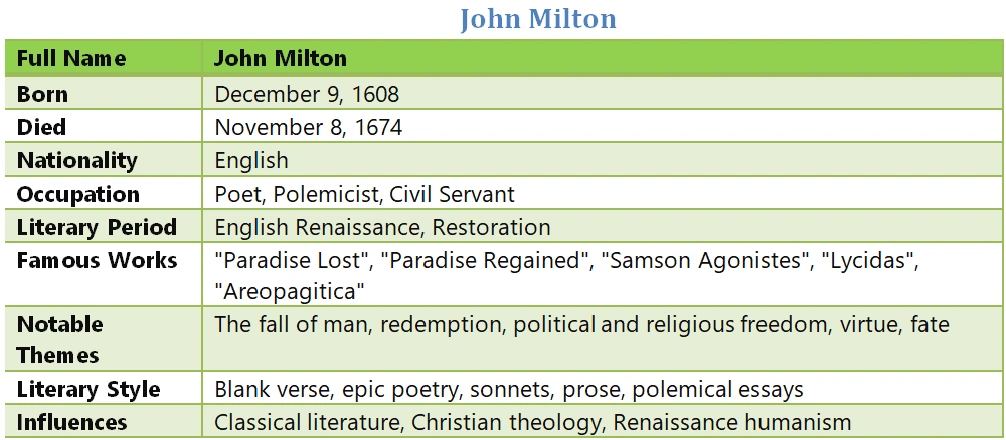
1. “Fame is the last infirmity of the noble mind.” In which poem of Milton does this line occur?
(A) Lycidas
(B) Paradise Regained
(C) Comus
(D) Samson Agonistes
2. How many English sonnets in all were written by Milton?
(A) 21
(B) 18
(C) 26
(D) 24
3. What is Milton’s Comus?
(A) A poetic play
(B) A Narrative poem
(C) A masque
(D) An elegy
4. Who encourages his followers in these words?
(A) Beelzebub
(B) Satan
(C) Moloch
(D) Baalim
5. What is Milton’s On the Nativity of Christ?
(A) A sonnet
(B) A lyric
(C) An Idyll
(D) An Ode
6. Lycidas is a pastoral elegy written by Milton on the death of his friend:
(A) Edward King
(B) Cromwell
(C) Arthur Hallam
(D) Lord Fairfax
7. Milton borrowed the idea/theme for Comus from:
(A) Homer’s Iliad
(B) Virgil’s Aeneid
(C) Homer’s Odyssey
(D) Spenser’s Fairie Queene
8. Milton derived the title for his Areopagitica from the Greek word ‘Areopagus’. What was Areopagus?
(A) The Greek God of Liberty
(B) A Greek King who supported freedom of speech
(C) A Greek hill where a tribunal for liberty of speech was held
(D) A Greek statesman who championed the cause of liberty of speech
9. “A mind not to be changed by place or time, The mind is its own place, and in itself Can make a Heaven of Hell, a Hell of Heaven.” These lines show the spirit of which of the following?
(A) Revolution
(B) Renaissance
(C) Puritanism
(D) Reformation
10. “Before the greatness displayed in Milton’s poem, all other greatness shrinks away. The weakest of his agents are the highest and noblest of human beings, the original parents of mankind.” Who admires Milton’s Paradise Lost in these words?
(A) Dryden
(B) Dr. Johnson
(C) Coleridge
(D) Hazlitt
11. Who said of Milton: “Thy soul was like a star, and dwelt apart”?
(A) Matthew Arnold
(B) Wordsworth
(C) Dr. Johnson
(D) Keats
12. “Milton, thou shouldst be living at this hour!” Who remembers Milton so passionately in a sonnet?
(A) Shelley
(B) Matthew Arnold
(C) Keats
(D) Wordsworth
13. Milton’s Paradise Lost is divided into the same number of Books as:
(A) Faerie Queen
(B) Iliad
(C) Odyssey
(D) Divine Comedy
14. Milton lived through:
(A) The Caroline, Commonwealth and Restoration Ages
(B) The Jacobean and Caroline Ages
(C) The Caroline and Commonwealth Ages
(D) The Elizabethan and Jacobean Ages
15. What post did Milton hold during the Government?
(A) Latin Secretary
(B) Personal Secretary to Cromwell
(C) Education Secretary
(D) Puritan Secretary
16. At what age did Milton become blind?
(A) At the age of 38
(B) At the age of 44
(C) At the age of 43
(D) At the age of 48
17. Who is next in command after Satan in Paradise Lost?
(A) Mammon
(B) Baalim
(C) Moloch
(D) Beelzebub
18. “What in me is dark Illumine, what is low raise and support.” In which Book of Paradise Lost do these lines appear?
(A) In Book IV
(B) In Book II
(C) In Book I
(D) In Book VI
19. How many Books are there in Paradise Lost?
(A) Eight
(B) Ten
(C) Twelve
(D) Six
20. Milton’s Samson Agonistes is:
(A) A poetic play
(B) A poetic Biography of Samson
(C) An Epic
(D) A narrative poem
21. Milton wrote Areopagitica:
(A) to defend the cause of the Regicides
(B) to condemn the deed of the Regicides
(C) to defend people’s Freedom of Speech
(D) to propagate his faith in Puritanism
22. Name the woman whom Samson Agonistes loved and who betrayed him:
(A) Helen
(B) Prosperpine
(C) Delilah
(D) Rosalind
23. How many times did Milton marry?
(A) Three times
(B) Two times
(C) Only once
(D) Did not marry at all
24. “Though fallen on evil days, On evil days though fallen, and evil tongues, In darkness, and with dangers compass’d round, And solitude.” In these words Milton describes a certain stage in his own life. When did such a stage occur in his life?
(A) When Charles I had been executed
(B) When Cromwell established the Commonwealth
(C) When the Age of Restoration came
(D) When his third wife passed away.
25. In which Book of Paradise Lost do Adam and Eve meet for the first time?
(A) Book I
(B) Book IV
(C) Book III
(D) Book II
26. Which Book of Paradise Lost begins with an invocation to light?
(A) Book III
(B) Book IV
(C) Book IX
(D) Book VI
27. Milton has written another poem entitled Il Penseroso. What is the exact meaning of the title?
(A) A very lively man
(B) A very brave man
(C) A very melancholy man
(D) A very tolerant man
28. In Milton’s famous Masque Comus, a significant character is Circe. Who was Circe?
(A) The beloved of Comus
(B) The Queen of fairies
(C) The mother of Comus
(D) The pastoral goddess
29. “Captain or Colonel, or Knight in Arms” This is the first line of a sonnet written by Milton. What is the title of the sonnet?
(A) To the Lord General Cromwell
(B) To the Lord General Fairfax
(C) When the Assault was Intended to the City
(D) On the Late Massacre in Piedmont
30. Milton wrote a sonnet on the death of his wife. The sonnet is entitled On His Deceased Wife. What was the name of his wife who was deceased?
(A) Elizabeth Minshull
(B) Mary Powell
(C) Not certain
(D) Catherine Woodcock
31. “They also serve who only stand and wait.” This is the concluding line of a sonnet written by Milton. What is the title of the sonnet?
(A) To Lord General Fairfax
(B) To Lord General Cromwell
(C) To Sir Henry Vane
(D) On His Blindness
32. Milton wrote a large number of political pamphlets and treatises. What were they called?
(A) Tracts
(B) Reviews
(C) Observations
(D) Treatises
33. “Of Man’s first disobedience, and the fruit of that forbidden tree whose mortal taste Brought death in the World, and all our woe.” What fruit was this?
(A) Apple
(B) Guava
(C) Mango
(D) Orange
34. “What though the field be lost? All is not lost-the unconquerable will And study of revenge…..” In which Book of Paradise Lost does Milton discuss the principles of Free Will and Divine Justice?
(A) In Book IX
(B) In Book IV
(C) In Book VI
(D) In Book III
35. Milton has written a poem entitled L’Allegro. What is the exact meaning of the title?
(A) A very hopeful man
(B) A very melancholy man
(C) A very jealous man
(D) A very cheerful man