Summary:
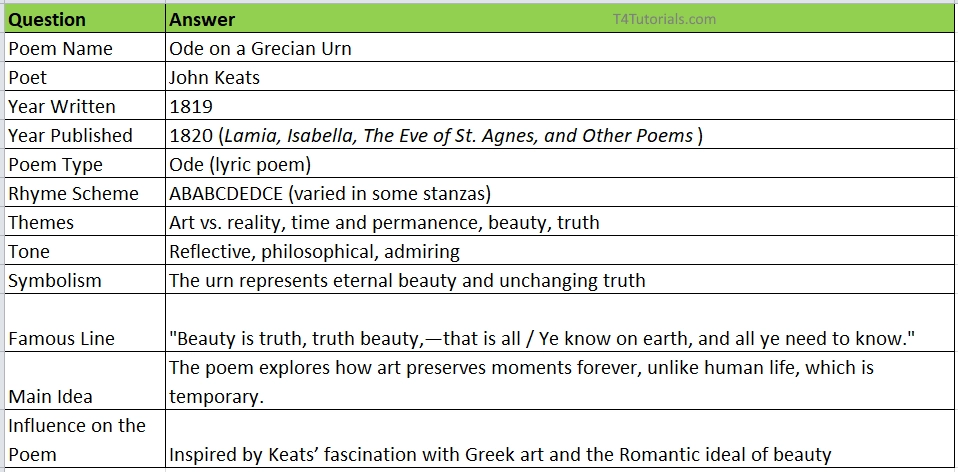
“Ode on a Grecian Urn” is one of John Keats’ most famous odes, written in 1819. The poem explores the relationship between art and life, focusing on an ancient Grecian urn that tells a silent yet eternal story through its images. Keats marvels at the figures on the urn—lovers, musicians, and pastoral scenes—who are forever frozen in time, untouched by decay or sorrow. The poem contrasts the permanence of art with the fleeting nature of human existence. It concludes with the famous philosophical statement: “Beauty is truth, truth beauty,” emphasizing that art captures an idealized reality that remains unchanged across generations.
| Question | Answer |
| Poem Name | Ode on a Grecian Urn |
| Poet | John Keats |
| Year Written | 1819 |
| Year Published | 1820 (Lamia, Isabella, The Eve of St. Agnes, and Other Poems) |
| Poem Type | Ode (lyric poem) |
| Rhyme Scheme | ABABCDEDCE (varied in some stanzas) |
| Themes | Art vs. reality, time and permanence, beauty, truth |
| Tone | Reflective, philosophical, admiring |
| Symbolism | The urn represents eternal beauty and unchanging truth |
| Famous Line | “Beauty is truth, truth beauty,—that is all / Ye know on earth, and all ye need to know.” |
| Main Idea | The poem explores how art preserves moments forever, unlike human life, which is temporary. |
| Influence on the Poem | Inspired by Keats’ fascination with Greek art and the Romantic ideal of beauty |
1. : Who wrote Ode on a Grecian Urn?
(A) William Wordsworth
(B) John Keats
(C) Lord Byron
(D) Samuel Taylor Coleridge
2. : In which year was Ode on a Grecian Urn written?
(A) 1817
(B) 1818
(C) 1819
(D) 1821
3. : When was the poem published?
(A) 1818
(B) 1820
(C) 1822
(D) 1825
4. : What is the central theme of the poem?
(A) The power of political revolution
(B) The relationship between art and life
(C) The struggles of romantic love
(D) The fleeting nature of war
5. : What does the Grecian urn symbolize?
(A) The fragility of nature
(B) Eternal beauty and timeless art
(C) The destruction of civilizations
(D) The rapid progress of technology
6. : What famous line concludes the poem?
(A) “A thing of beauty is a joy forever.”
(B) “Thou wast not born for death, immortal Bird!”
(C) “Beauty is truth, truth beauty,—that is all / Ye know on earth, and all ye need to know.”
(D) “Season of mists and mellow fruitfulness.”
7. : What type of poem is Ode on a Grecian Urn?
(A) Sonnet
(B) Ballad
(C) Lyric
(D) Ode
8. : What scene is NOT depicted on the urn?
(A) Lovers frozen in time
(B) Musicians playing forever
(C) A priest leading a sacrifice
(D) A battle between soldiers
9. : How does Keats contrast art and reality in the poem?
(A) By showing that real life is more perfect than art
(B) By suggesting that art captures eternal beauty, unlike human life
(C) By arguing that art is meaningless compared to real experiences
(D) By proving that nature is the only true form of art
10. : What does Keats mean by “unheard melodies are sweeter”?
(A) Music is not important in poetry
(B) Imagination is more powerful than reality
(C) Silence is more enjoyable than sound
(D) The poet dislikes music
11. : Who wrote Ode on a Grecian Urn?
(A) William Wordsworth
(B) John Keats
(C) Lord Byron
(D) Samuel Taylor Coleridge
12. : In which year was Ode on a Grecian Urn written?
(A) 1817
(B) 1818
(C) 1819
(D) 1821
13. : When was the poem published?
(A) 1818
(B) 1820
(C) 1822
(D) 1825
14. : What is the central theme of the poem?
(A) The power of political revolution
(B) The relationship between art and life
(C) The struggles of romantic love
(D) The fleeting nature of war
15. : What does the Grecian urn symbolize?
(A) The fragility of nature
(B) Eternal beauty and timeless art
(C) The destruction of civilizations
(D) The rapid progress of technology
16. : What famous line concludes the poem?
(A) “A thing of beauty is a joy forever.”
(B) “Thou wast not born for death, immortal Bird!”
(C) “Beauty is truth, truth beauty,—that is all / Ye know on earth, and all ye need to know.”
(D) “Season of mists and mellow fruitfulness.”
17. : What type of poem is Ode on a Grecian Urn?
(A) Sonnet
(B) Ballad
(C) Lyric
(D) Ode
18. : What scene is NOT depicted on the urn?
(A) Lovers frozen in time
(B) Musicians playing forever
(C) A priest leading a sacrifice
(D) A battle between soldiers
19. : How does Keats contrast art and reality in the poem?
(A) By showing that real life is more perfect than art
(B) By suggesting that art captures eternal beauty, unlike human life
(C) By arguing that art is meaningless compared to real experiences
(D) By proving that nature is the only true form of art
20. : What does Keats mean by “unheard melodies are sweeter”?
(A) Music is not important in poetry
(B) Imagination is more powerful than reality
(C) Silence is more enjoyable than sound
(D) The poet dislikes music