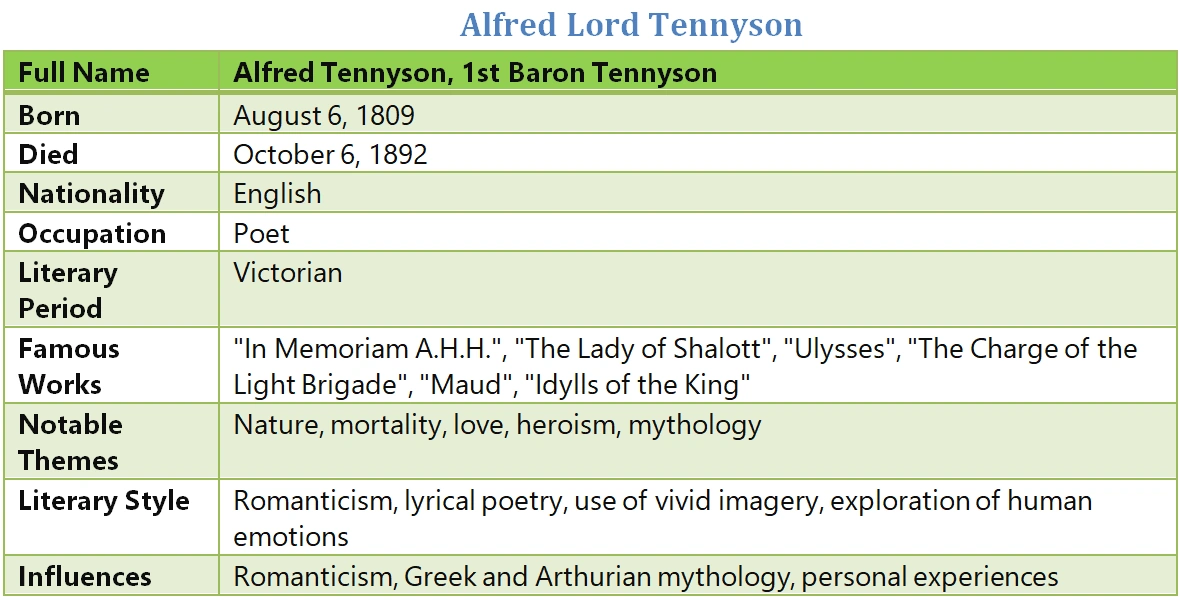
1. What is Tennyson’s “Maud”?
(A) A narrative poem
(B) A Monodrama
(C) A mythological tale
(D) A prose romance
2. “The Cup” is a drama written by Tennyson. What type of drama is it?
(A) A Comedy
(B) A Trag-Comedy
(C) A Farce
(D) A Tragedy
3. “And may there be no moaning of the bar, When I put out to sea.” These lines occur in Tennyson’s:
(A) Crossing the Bar
(B) Break, Break, Break
(C) In Memoriam
(D) Ulysses
4. Which poem of Tennyson won him the Chancellor’s medal at Cambridge?
(A) Charge of the Light Brigade
(B) Crossing the Bar
(C) Lotos-Eaters
(D) Timbuctoo
5. “Let knowledge grow from more to more…” These lines from “In Memoriam” imply:
(A) Compromise between knowledge and faith
(B) Supremacy of faith over knowledge
(C) Supremacy of knowledge over faith
(D) Supremacy of religion over both
6. When Tennyson died, which Shakespeare play was found under his bed?
(A) The Tempest
(B) King Lear
(C) Hamlet
(D) Cymbeline
7. Queen Guinevere appears in Tennyson’s:
(A) Maud
(B) Ulysses
(C) Passing of Arthur
(D) The Coming of Arthur
8. Tennyson idealizes married life in:
(A) Queen Mab
(B) The Princess
(C) Maud
(D) The Miller’s Daughter
9. Tennyson belongs to which historical Age?
(A) The Victorian Age
(B) The middle Georgian Age
(C) The later Georgian Age
(D) None of these
10. Tennyson became Poet Laureate after:
(A) William Wordsworth
(B) Robert Southey
(C) S.T. Coleridge
(D) Robert Browning
11. “In Memoriam” mourns the death of:
(A) Keats
(B) Arthur Hallam
(C) Hugh Clough
(D) Lord Byron
12. How many years did Tennyson take to complete “In Memoriam”?
(A) Two years
(B) Seven years
(C) Seventeen years
(D) Eleven years
13. Tennyson’s “Queen Mary” is an example of:
(A) Drama
(B) Novel
(C) Verse Tale
(D) Novelette
14. The poem that closes with “To which the whole creation moves” is:
(A) Sir Galahad
(B) Maud
(C) Crossing the Bar
(D) In Memoriam
15. The theme of “Idylls of the King” is:
(A) The Voyage of Hercules
(B) Greek Kings and Helen of Troy
(C) Roman Emperors’ Victories
(D) King Arthur and His Round Table
16. “For men may come and men may go…” appears in:
(A) The Song of the Lotus
(B) Early Spring
(C) The Brook
(D) Break, Break, Break
17. King Cophetua is a character in:
(A) Sir Galahad
(B) A Dream of Fair Women
(C) The Sleeping Beauty
(D) The Beggar Maid
18. “There she weaves by night and day…” comes from:
(A) The Lady of Shalott
(B) The Princess
(C) Maud
(D) Queen Mary
19. “Dear is the memory of our wedded lives…” appears in:
(A) The Lotos-Eaters
(B) Ulysses
(C) Passing of Arthur
(D) Morte D’ Arthur
20. Tennyson’s “Enoch Arden” is:
(A) A Monologue
(B) A drama
(C) A narrative poem
(D) A ballad
21. “Volley’d and thunder’d” appears in:
(A) Morte D’ Arthur
(B) Charge of the Heavy Brigade
(C) Charge of the Light Brigade
(D) Ulysses
22. “We have but faith: we cannot know…” comes from:
(A) The Promise of May
(B) Queen Mary
(C) The Two Voices
(D) In Memoriam
23. How many parts are in “Maud: A Monodrama”?
(A) Two
(B) Four
(C) Three
(D) Five
24. Tennyson wrote a poem on the tomb of which Mughal Emperor?
(A) Aurengzeb
(B) Akbar
(C) Shahjahan
(D) Jahangir
25. Tennyson wrote a poem about which Indian city?
(A) Jhansi
(B) Calcutta
(C) Delhi
(D) Lucknow
26. The only surviving knight after Arthur’s passing is:
(A) Galahad
(B) Bedivere
(C) Merlin
(D) Lancelot
27. Tennyson generally portrays women as:
(A) Refined
(B) Intelligent
(C) Coquettes
(D) Suppressed ones
28. “The old order changeth…” appears in:
(A) The Coming of Arthur
(B) The Holy Grail
(C) The Round Table
(D) The Passing of Arthur
29. “Man for the field and woman for the hearth…” comes from:
(A) The Lady of Shalott
(B) Locksley Hall
(C) The Princess
(D) Ulysses