
Summary:
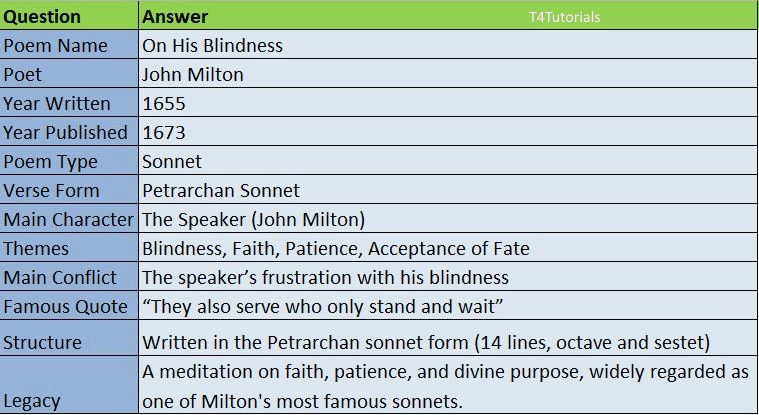
On His Blindness is a sonnet written by John Milton in which he reflects on the difficulties he faces due to his blindness. The poem is deeply personal, expressing Milton’s feelings of frustration and helplessness as he contemplates his inability to use his talent for writing because of his blindness. However, the poem also conveys a sense of resignation and faith in God’s will. Milton concludes that it is better to serve God in whatever way possible rather than in the way one desires, and he resolves that God does not need his work to be glorified—God can use any means to achieve divine purposes. The poem, therefore, emphasizes the themes of patience, faith, and acceptance of one’s fate.
1. : What is the central theme of On His Blindness?
(A) Loss of power
(B) Frustration with blindness
(C) The importance of fame
(D) The search for knowledge
2. : What literary form is On His Blindness written in?
(A) Haiku
(B) Sonnet
(C) Free Verse
(D) Blank Verse
3. : Who does the speaker express his concern about his blindness to in the poem?
(A) God
(B) His wife
(C) A fellow poet
(D) Himself
4. : What does the speaker realize about God’s work in On His Blindness?
(A) That he must continue to work despite his blindness
(B) That God does not need his help to accomplish His will
(C) That God has cursed him for his pride
(D) That he must work harder than ever before
5. : How does the speaker reconcile his blindness in On His Blindness?
(A) By accepting it as a divine plan
(B) By seeking medical help
(C) By praying for a cure
(D) By retreating into despair
6. : What does the phrase “They also serve who only stand and wait” suggest in the poem?
(A) That inaction is just as valuable as action in God’s service
(B) That waiting is futile and a waste of time
(C) That standing still will not lead to success
(D) That waiting is a form of rebellion against God
7. : What emotion dominates the speaker’s tone at the beginning of On His Blindness?
(A) Hope
(B) Anger
(C) Frustration
(D) Joy
8. : Which poetic device is most evident in the phrase “That one talent which is death to hide”?
(A) Metaphor
(B) Hyperbole
(C) Personification
(D) Alliteration
9. : What realization does the speaker come to by the end of On His Blindness?
(A) That blindness is a punishment
(B) That his work is no longer important
(C) That God’s will is to be accepted, even in silence
(D) That he must find a way to write despite his blindness
10. : What is the overall mood of On His Blindness?
(A) Anger and rebellion
(B) Sorrow and acceptance
(C) Joy and optimism
(D) Grief and despair