Summary:
Charles Lamb’s poem “The Old Familiar Faces” is a melancholic reflection on loss, memory, and nostalgia. The poet recalls the people who were once a significant part of his life but are now gone—either due to death, distance, or time. The repeated phrase “the old familiar faces” emphasizes his deep sense of longing and sorrow.
Lamb mentions childhood friends, family members, and loved ones, highlighting how their absence has left him feeling lonely. He particularly reflects on personal tragedies, including the loss of his mother and close companions. The poem conveys a universal emotion—the pain of losing loved ones and reminiscing about the past.
Through simple yet powerful language, Lamb captures the fleeting nature of life and relationships. The poem serves as a poignant reminder of how time changes everything, leaving behind only memories of “the old familiar faces.”
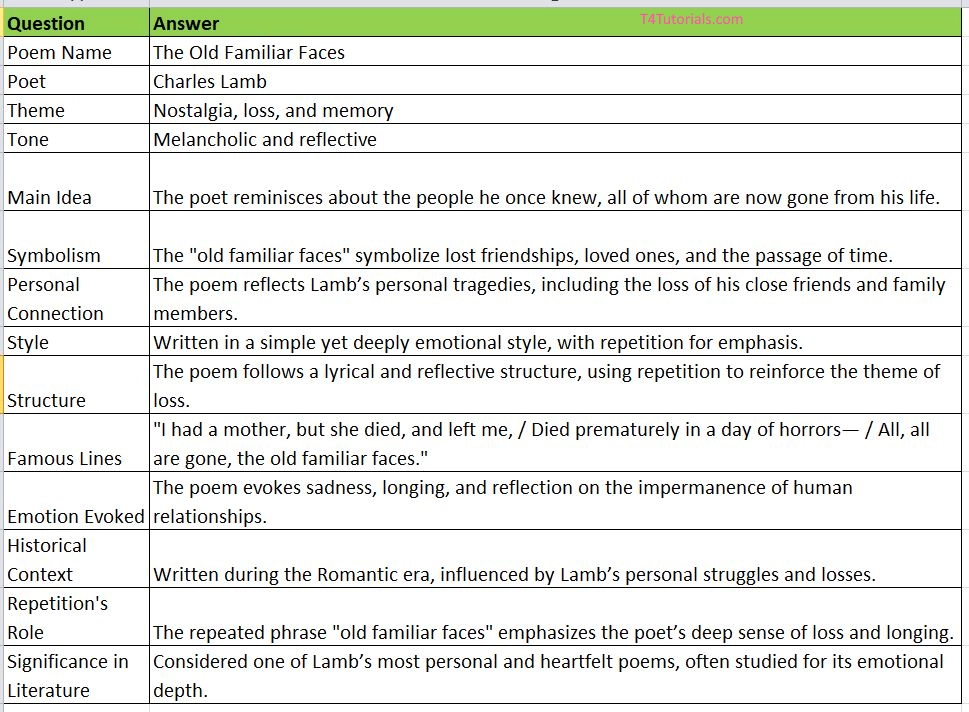
| Question | Answer |
| Poem Name | The Old Familiar Faces |
| Poet | Charles Lamb |
| Theme | Nostalgia, loss, and memory |
| Tone | Melancholic and reflective |
| Main Idea | The poet reminisces about the people he once knew, all of whom are now gone from his life. |
| Symbolism | The “old familiar faces” symbolize lost friendships, loved ones, and the passage of time. |
| Personal Connection | The poem reflects Lamb’s personal tragedies, including the loss of his close friends and family members. |
| Style | Written in a simple yet deeply emotional style, with repetition for emphasis. |
| Structure | The poem follows a lyrical and reflective structure, using repetition to reinforce the theme of loss. |
| Famous Lines | “I had a mother, but she died, and left me, / Died prematurely in a day of horrors— / All, all are gone, the old familiar faces.” |
| Emotion Evoked | The poem evokes sadness, longing, and reflection on the impermanence of human relationships. |
| Historical Context | Written during the Romantic era, influenced by Lamb’s personal struggles and losses. |
| Repetition’s Role | The repeated phrase “old familiar faces” emphasizes the poet’s deep sense of loss and longing. |
| Significance in Literature | Considered one of Lamb’s most personal and heartfelt poems, often studied for its emotional depth. |
1. : What is the main theme of “The Old Familiar Faces”?
(A) Love and romance
(B) War and heroism
(C) Nostalgia and loss
(D) Adventure and discovery
2. : Which literary device is most frequently used in the poem?
(A) Metaphor
(B) Repetition
(C) Alliteration
(D) Simile
3. : What does the phrase “the old familiar faces” symbolize?
(A) Strangers from different places
(B) Memories of lost loved ones and friends
(C) The poet’s new acquaintances
(D) Faces seen in dreams
4. : How does the tone of the poem change throughout?
(A) From happy to hopeful
(B) From joyful to sorrowful
(C) From fearful to relieved
(D) From angry to peaceful
5. : What personal tragedy influenced Charles Lamb’s writing of this poem?
(A) Loss of wealth
(B) The death of his mother and friends
(C) War experience
(D) Political exile
6. : In which literary era was “The Old Familiar Faces” written?
(A) Victorian Era
(B) Modernist Period
(C) Romantic Era
(D) Renaissance Period
7. : What emotion does the poem primarily evoke in the reader?
(A) Excitement
(B) Nostalgia and sadness
(C) Humor
(D) Anger
8. : Which poetic structure does Lamb use in this poem?
(A) Sonnet
(B) Free verse
(C) Lyrical and reflective style
(D) Haiku
9. : Why does the poet repeat the phrase “the old familiar faces”?
(A) To emphasize his sense of loss
(B) To create a musical effect
(C) To confuse the reader
(D) To express happiness
10. : What does the poem suggest about human relationships?
(A) They are eternal and unchanging
(B) They often fade with time and circumstances
(C) They have no impact on a person’s life
(D) They are based only on material wealth