
Summary:
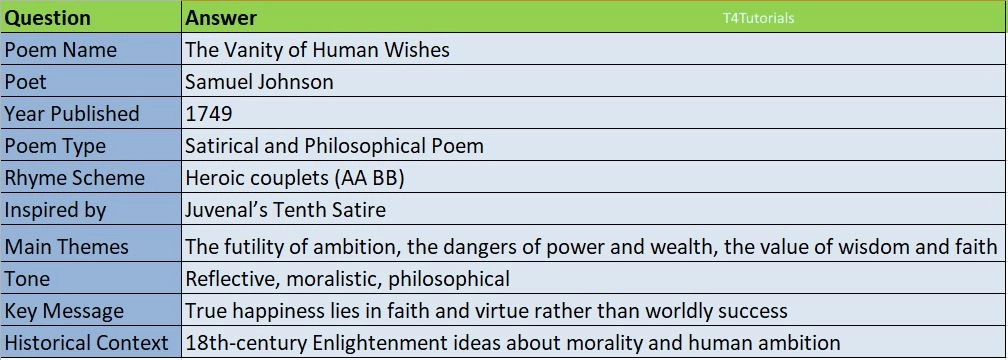
Samuel Johnson’s The Vanity of Human Wishes is a satirical and philosophical poem that critiques the futility of human ambitions. Inspired by Juvenal’s Tenth Satire, the poem explores how mankind’s relentless pursuit of power, wealth, knowledge, and pleasure often leads to disappointment, suffering, or downfall.
Johnson examines historical and contemporary figures, demonstrating how their aspirations resulted in misfortune rather than fulfillment. He emphasizes that material success is fleeting and warns against trusting in human desires, which are often misguided.
The poem ultimately advises readers to seek wisdom, humility, and faith in divine providence, as true happiness lies in spiritual contentment rather than worldly achievements. Johnson conveys his message through heroic couplets, reinforcing his moralistic and reflective tone.
1. : Who wrote The Vanity of Human Wishes?
(A) John Milton
(B) Samuel Johnson
(C) Alexander Pope
(D) William Blake
2. : Which classical poet’s work influenced Johnson’s poem?
(A) Virgil
(B) Ovid
(C) Juvenal
(D) Horace
3. : What is the main theme of the poem?
(A) The importance of ambition
(B) The fleeting nature of human desires
(C) The beauty of nature
(D) The struggle between good and evil
4. : What poetic form is used in The Vanity of Human Wishes?
(A) Blank verse
(B) Free verse
(C) Heroic couplets
(D) Sonnet
5. : What is the tone of the poem?
(A) Playful and humorous
(B) Moralistic and reflective
(C) Hopeful and romantic
(D) Cynical and angry
6. : What does Johnson argue about wealth and power?
(A) They always bring happiness
(B) They are dangerous and often lead to misery
(C) They should be the ultimate goal in life
(D) They have no impact on people’s lives
7. : What advice does Johnson give at the end of the poem?
(A) Trust in human wisdom
(B) Seek faith and humility
(C) Pursue fame and fortune
(D) Ignore moral values
8. : Which literary device is frequently used in the poem?
(A) Metaphor
(B) Satire
(C) Personification
(D) All of the above
9. : What does Johnson use to illustrate the dangers of ambition?
(A) Mythological references
(B) Historical and contemporary examples
(C) Scientific theories
(D) Personal experiences
10. : What does the poem suggest about human nature?
(A) People are always satisfied with what they have
(B) People are often deceived by their own desires
(C) Humans should abandon all ambitions
(D) People can control their own fate completely