
Summary:
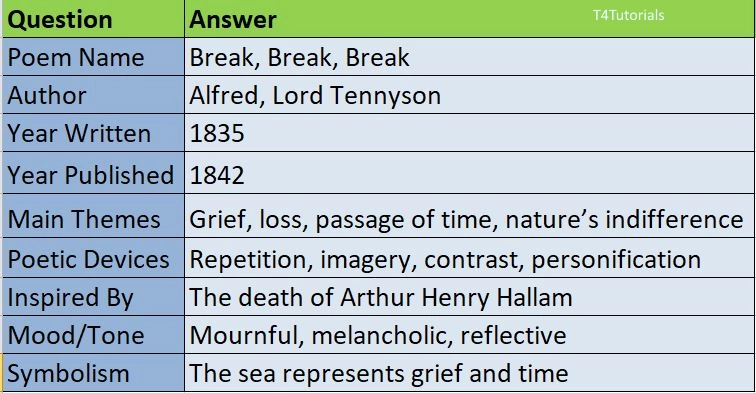
“Break, Break, Break” is a lyric poem written by Alfred, Lord Tennyson in 1835 and published in 1842. It is an elegy expressing deep grief and sorrow over the death of Tennyson’s close friend, Arthur Henry Hallam. The poem is set by the sea, where the speaker watches the waves continuously break against the shore, symbolizing the relentless passage of time and the unchanging nature of grief.
The speaker contrasts his sorrow with the carefree lives of others, such as children playing and sailors working. He longs to express his pain but feels incapable of putting it into words. The poem’s themes include mourning, the passage of time, nature’s indifference to human suffering, and the irreversibility of loss. Through repetition, imagery, and contrast, Tennyson conveys the depth of his sorrow and the enduring nature of grief.
1. : Who wrote Break, Break, Break?
(A) William Wordsworth
(B) Robert Browning
(C) Alfred, Lord Tennyson
(D) John Keats
2. : What inspired the poem?
(A) Tennyson’s love for the sea
(B) The death of his friend, Arthur Henry Hallam
(C) A war he witnessed
(D) A tragic love story
3. : What does the speaker compare his grief to?
(A) A stormy night
(B) The breaking waves of the sea
(C) The howling wind
(D) A setting sun
4. : What emotion dominates the poem?
(A) Joy
(B) Love
(C) Sorrow
(D) Anger
5. : What contrast does the poet use in the poem?
(A) The speaker’s grief vs. the joyful activities of others
(B) The stormy sea vs. the calm sky
(C) The past vs. the future
(D) The speaker’s loneliness vs. a crowded marketplace
6. : What literary device is used in the phrase “Break, break, break”?
(A) Simile
(B) Metaphor
(C) Repetition
(D) Alliteration
7. : What does the sea symbolize in the poem?
(A) The unpredictability of life
(B) The power of nature
(C) The speaker’s grief and time’s relentless passage
(D) The importance of travel
8. : What is the speaker unable to do?
(A) Forget his friend
(B) Express his grief fully
(C) Move to a new place
(D) Face the sea
9. : How does the speaker feel about the past?
(A) He longs for it and mourns its loss
(B) He wants to forget it
(C) He is indifferent to it
(D) He wishes he had never met his friend
10. : What is the tone of the poem?
(A) Hopeful and optimistic
(B) Angry and bitter
(C) Melancholic and mournful
(D) Joyful and celebratory