

This tutorial covers the concepts of Round Robin Scheduling.
Round Robin Scheduling is the preemptive scheduling algorithm.
We assign a fixed time to all processes for execution, this time is called time quantum.
All processes can execute only until their time quantum and then leave the CPU and give a chance to other processes to complete their execution according to time quantum.
Context switching mechanisms store the states of preempted processes.
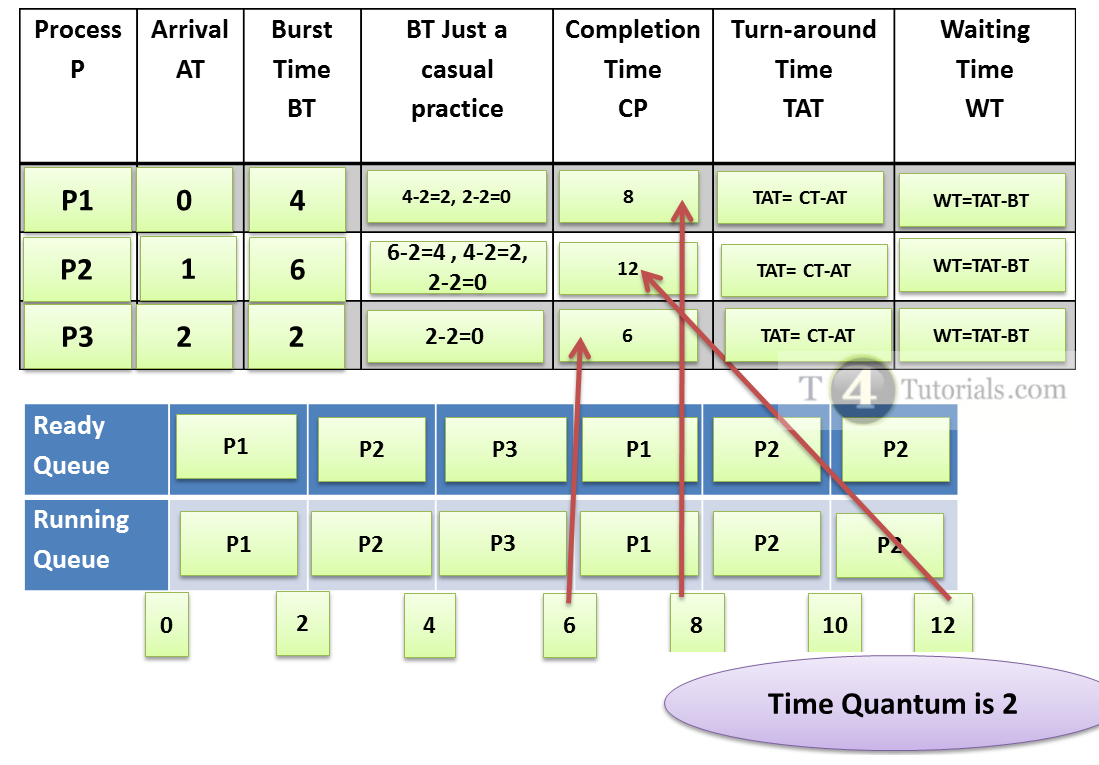
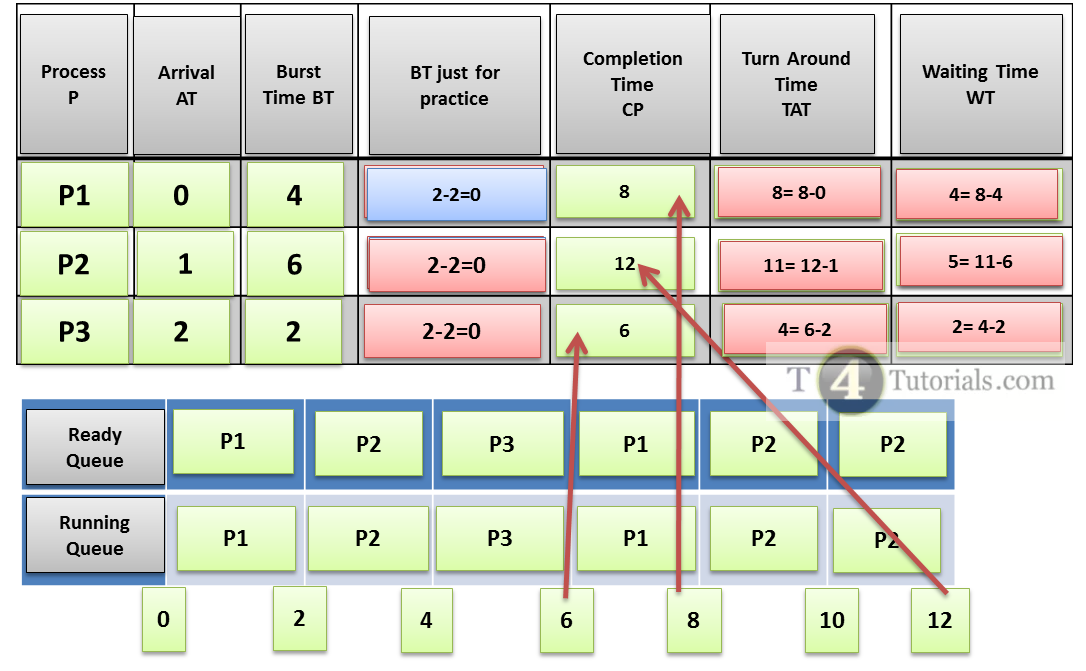
The formula of Round robin Turn Around Time = Completion Time – Arrival Time
The formula of Round robin Waiting Time(W.T): Time Difference between the turnaround and the burst time.
The formula of Round robin Waiting Time = Turn Around Time – Burst Time
Examples of Round-robin scheduling
Let’s see a round-robin scheduling example with arrival time, burst time, waiting time, and time quantum.
Time quantum = 2
Animation and Video of Round Robin Scheduling

Advantage of Round-robin Scheduling
There are many advantages of Round-robin Scheduling. Some of the advantages are mentioned below;
- Round-robin Scheduling avoids starvation or convoy effect.
- In Round-robin Scheduling , all the jobs get a fair and efficient allocation of CPU.
- Round-robin Scheduling don’t care about priority of the processes.
- Round-robin Scheduling gives the best performance in terms of average response time.
- We can assume the worst case response time for the process, If we know the total number of processes on the running queue.
- Round-robin Scheduling is easily implementable on the system because it does not depend upon burst time.
- Round-robin Scheduling promotes Context switching to save the states of the preempted processes.
Disadvantages of Round-robin Scheduling
- There are many disadvantages of Round-robin Scheduling. Some of the disadvantages are mentioned below;
- Round-robin Scheduling utilize more time on context switching which is not good in some cases.
- The processor output will be reduced in Round-robin Scheduling, If slicing time of OS is low.
- If the time quantum is low, then it increases the context switching time in Round-robin Scheduling .
- Round-robin Scheduling can leads to decreases the comprehension
- In Round-robin Scheduling , it’s a difficult task to decide a correct time quantum to increase the efficiency and speed.
- In Round-robin Scheduling , We can’t set priorities for the processes.
- Performance of Round-robin Scheduling heavily depends on time quantum given to the processes.
Round robin scheduling program in C
#include<stdio.h>

int main()
{

  int T4Tutorials_counter,j,n,time,Remaining,flag=0,time_quantum;
  int wait_time=0,turnaround_time=0,Arrival_Time[10],Burst_Time[10],rt[10];
  printf("Enter Total Process:\t ");
  scanf("%d",&n);
  Remaining=n;
  for(T4Tutorials_counter=0;T4Tutorials_counter<n;T4Tutorials_counter++)
  {
    printf("Enter Arrival Time and Burst Time for Process Process Number %d :",T4Tutorials_counter+1);
    scanf("%d",&Arrival_Time[T4Tutorials_counter]);
    scanf("%d",&Burst_Time[T4Tutorials_counter]);
    rt[T4Tutorials_counter]=Burst_Time[T4Tutorials_counter];
  }
  printf("Enter Time Quantum:\t");
  scanf("%d",&time_quantum);
  printf("\n\nProcess\t|Turnaround Time|Waiting Time\n\n");
  for(time=0,T4Tutorials_counter=0;Remaining!=0;)
  {
    if(rt[T4Tutorials_counter]<=time_quantum && rt[T4Tutorials_counter]>0)
    {
      time+=rt[T4Tutorials_counter];
      rt[T4Tutorials_counter]=0;
      flag=1;
    }
    else if(rt[T4Tutorials_counter]>0)
    {
      rt[T4Tutorials_counter]-=time_quantum;
      time+=time_quantum;
    }
    if(rt[T4Tutorials_counter]==0 && flag==1)
    {
      Remaining--;
      printf("P[%d]\t|\t%d\t|\t%d\n",T4Tutorials_counter+1,time-Arrival_Time[T4Tutorials_counter],time-Arrival_Time[T4Tutorials_counter]-Burst_Time[T4Tutorials_counter]);
      wait_time+=time-Arrival_Time[T4Tutorials_counter]-Burst_Time[T4Tutorials_counter];
      turnaround_time+=time-Arrival_Time[T4Tutorials_counter];
      flag=0;
    }
    if(T4Tutorials_counter==n-1)
      T4Tutorials_counter=0;
    else if(Arrival_Time[T4Tutorials_counter+1]<=time)
      T4Tutorials_counter++;
    else
      T4Tutorials_counter=0;
  }
  printf("\nAverage Waiting Time= %f\n",wait_time*1.0/n);
  printf("Avg Turnaround Time = %f",turnaround_time*1.0/n);

  return 0;
}
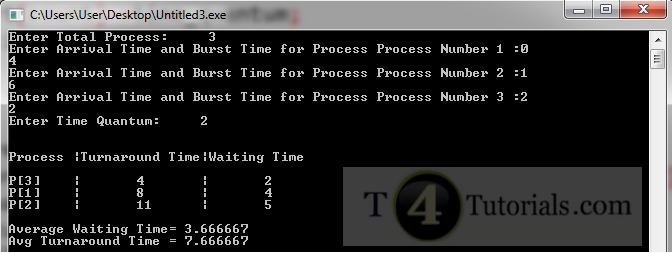
Output
Round robin scheduling program in C++
#include <iostream>
#include <vector>

using namespace std;

int main() {
    int T4Tutorials_counter, j, n, time, Remaining, flag = 0, time_quantum;
    int wait_time = 0, turnaround_time = 0;

    cout << "Enter Total Process:\t ";
    cin >> n;

    Remaining = n;
    vector<int> Arrival_Time(n), Burst_Time(n), rt(n);

    for (T4Tutorials_counter = 0; T4Tutorials_counter < n; T4Tutorials_counter++) {
        cout << "Enter Arrival Time and Burst Time for Process Process Number " << T4Tutorials_counter + 1 << ": ";
        cin >> Arrival_Time[T4Tutorials_counter];
        cin >> Burst_Time[T4Tutorials_counter];
        rt[T4Tutorials_counter] = Burst_Time[T4Tutorials_counter];
    }

    cout << "Enter Time Quantum:\t";
    cin >> time_quantum;

    cout << "\n\nProcess\t|Turnaround Time|Waiting Time\n\n";

    for (time = 0, T4Tutorials_counter = 0; Remaining != 0;) {
        if (rt[T4Tutorials_counter] <= time_quantum && rt[T4Tutorials_counter] > 0) {
            time += rt[T4Tutorials_counter];
            rt[T4Tutorials_counter] = 0;
            flag = 1;
        } else if (rt[T4Tutorials_counter] > 0) {
            rt[T4Tutorials_counter] -= time_quantum;
            time += time_quantum;
        }

        if (rt[T4Tutorials_counter] == 0 && flag == 1) {
            Remaining--;
            cout << "P[" << T4Tutorials_counter + 1 << "]\t|\t" << time - Arrival_Time[T4Tutorials_counter] << "\t|\t" << time - Arrival_Time[T4Tutorials_counter] - Burst_Time[T4Tutorials_counter] << endl;
            wait_time += time - Arrival_Time[T4Tutorials_counter] - Burst_Time[T4Tutorials_counter];
            turnaround_time += time - Arrival_Time[T4Tutorials_counter];
            flag = 0;
        }

        if (T4Tutorials_counter == n - 1)
            T4Tutorials_counter = 0;
        else if (Arrival_Time[T4Tutorials_counter + 1] <= time)
            T4Tutorials_counter++;
        else
            T4Tutorials_counter = 0;
    }

    cout << "\nAverage Waiting Time= " << (float)wait_time / n << endl;
    cout << "Avg Turnaround Time = " << (float)turnaround_time / n << endl;

    return 0;
}
Round Robin Implementation in Java
Let us see the Round Robin Implementation in Java.
import java.util.*;
class ROUND_ROBIN_SCHEDULING
{
            Scanner sc=new Scanner(System.in);
            int[] bur, wai,ta, extra_variable,;
int t=0;
int flag=0;
 int total_size,q;
int b=0;
            ROUND_ROBIN_SCHEDULING(int total_size)
            {
                        this.total_size=total_size;
                        ta=new int[total_size];
                        extra_variable=new int[total_size];

                        bur=new int[total_size];
                        wai=new int[total_size];

            }
            void get()
            {
                        for(int i=0;i<total_size;i++)
                        {
                                    System.out.print("Enter burst time of P"+(i+1)+":");
                                    bur[i]=extra_variable[i]=sc.nextInt();
                        }
                        System.out.print("Enter quantum time:");
                        q=sc.nextInt();
            }
            void round()
            {
                        do{
                                    flag=0;
                                    for(int i=0;i<total_size;i++)
                                    {
                                                if(extra_variable[i]>=q)
                                                {
                                                            System.out.print("P"+(i+1)+"\t");
                                                            for(int j=0;j<total_size;j++)
                                                            {
                                                                        if(j==i)
                                                                                    extra_variable[i]=extra_variable[i]-q;
                                                                        else if(extra_variable[j]>0)
                                                                                    wai[j]+=q;
                                                            }
                                                }
                                                else if(extra_variable[i]>0)
                                                {
                                                            System.out.print("P"+(i+1)+"\t");
                                                            for(int j=0;j<total_size;j++)
                                                            {
                                                                        if(j==i)
                                                                                    extra_variable[i]=0;
                                                                        else if(extra_variable[j]>0)
                                                                                    wai[j]+=extra_variable[i];
                                                            }
                                                }
                                    }
                                    for(int i=0;i<total_size;i++)
                                                if(extra_variable[i]>0)
                                                            flag=1;
                        }while(flag==1);
                        for(int i=0;i<total_size;i++)
                                    ta[i]=wai[i]+bur[i];
            }
            void display()
            {
                        System.out.println("\nProcess\tBurst\tWaiting\tTurnaround");
                        for(int i=0;i<total_size;i++)
                        {
                                    System.out.println("P"+(i+1)+"\t"+bur[i]+"\t"+wai[i]+"\t"+ta[i]);
                                    b+=wai[i];
                                    t+=ta[i];
                        }
                        System.out.println("Average waiting time is?"+(b/total_size));
                        System.out.println("Average Turnaround time is?"+(t/total_size));
            }
}
class KROUND_ROBIN_SCHEDULING
{
            public static void main(String arg[])
            {
                        Scanner s=new Scanner(System.in);
                        System.out.print("Please Enter the total no of process:");
                        int n=s.nextInt();
                        ROUND_ROBIN_SCHEDULING obj = new ROUND_ROBIN_SCHEDULING(n);
                        obj.get();
                        obj.round();
                        obj.display();
            }
}
Exercise on Round Robin Process Scheduling algorithm with Solution