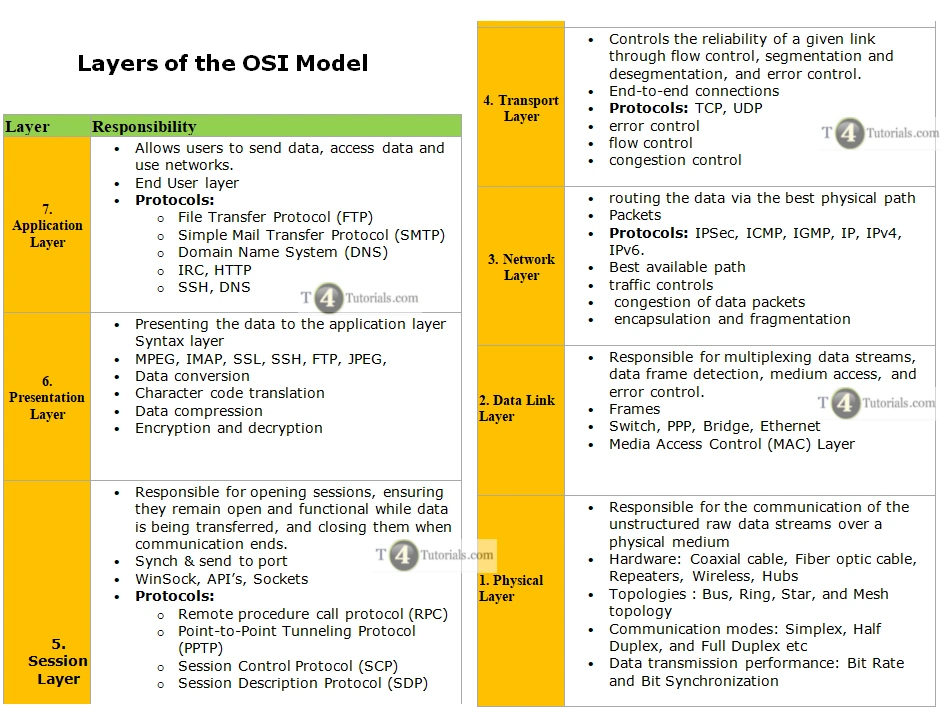
1. The physical layer concerns with?
(A) Process to process delivery
(B) Bit-by-bit delivery
(C) Application to application delivery
(D) None of the mentioned
2. The term that refers to a physical layer technique is called?
(A) FDMA
(B) CDMA
(C) TDMA
(D) TDM
3. A message that travels over a physical path is called?
(A) Signals
(B) Medium
(C) Protocols
(D) All of the above
4. The _____ is the portion of the physical layer that interfaces with the media access control sublayer?
(A) Physical address sublayer
(B) Physical data sublayer
(C) Physical signaling sublayer
(D) None of the mentioned
5. The physical layer is responsible for the movement of individual?
(A) Frames
(B) Bits
(C) Packets
(D) Bytes
6. The physical layer is responsible for?
(A) Line coding
(B) Channel coding
(C) Modulation
(D) All of the mentioned
7. A device that operates below the physical layer of the OSI model is?
(A) Active hub
(B) Repeater
(C) Bridge
(D) Passive hub
8. IEEE 802.11 covers the physical layer and?
(A) Data link layer
(B) Network layer
(C) Session layer
(D) Transport layer
9. The physical layer translates logical communication requests made by the ______ into hardware-specific operations.
(A) Data link layer
(B) Network layer
(C) Physical layer
(D) Application layer
10. Wireless transmission can be done via?
(A) Microwaves
(B) Radio waves
(C) Infrared
(D) All of the mentioned
11. The network layer lies on ______ layer.
(A) Physical
(B) Data link
(C) Network
(D) Transport
12. The ______ layer changes bits into electromagnetic signals.
(A) Physical
(B) Data link
(C) Transport
(D) Network
13. During the data transmission process, which layer of the OSI model prevents itself from adding its own header?
(A) Network layer
(B) Application layer
(C) Physical layer
(D) None of the above