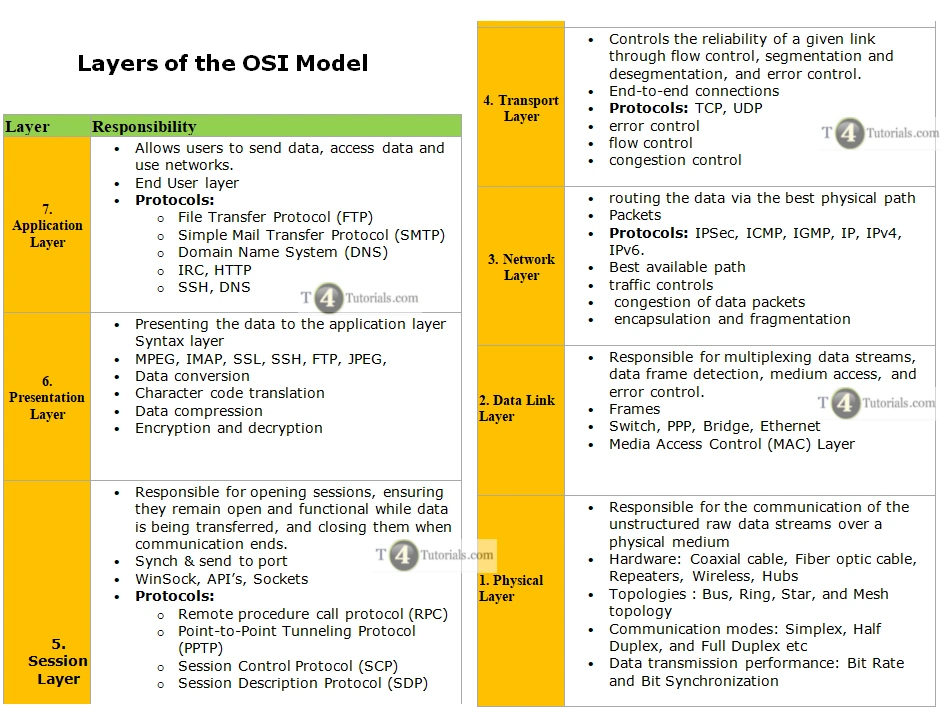
1. Which results are more likely to occur during the frame transmission in Stop-and-Wait ARQ technique?
(A) Loss of frame or an acknowledgement
(B) Delay in an acknowledgement
(C) All of the above
(D) Normal operation
2. Frames issued by the secondary station of High-level data link control are known as?
(A) Response
(B) Command
(C) Link
(D) None of the above
3. Which technique are more likely to occur during the frame transmission in the Stop-and-Wait ARQ technique?
(A) Loss of frame or an acknowledgement
(B) Delay in an acknowledgement
(C) Normal operation
(D) All of the above
4. The category of High-level data link control frames that undergoes error & flow control techniques by comprising send and receive sequence numbers is?
(A) U-frames
(B) S-frames
(C) I-frames
(D) All of the above
5. The data link layer takes the packets from _________ and sends them into frames for transmission.
(A) Application layer
(B) Physical layer
(C) Network layer
(D) All of the above
6. The data link layer is not able to perform?
(A) Channel coding
(B) Flow control
(C) Error control
(D) Framing
7. The data link layer divides the stream of bits received from the network layer into data units known as?
(A) Frame
(B) Segment
(C) Datagrams
(D) Message
8. CRC is abbreviated as?
(A) Code redundancy check
(B) Code repeat check
(C) Cyclic redundancy check
(D) Cyclic repeat check
9. Data link protocol known as?
(A) HDLC
(B) Point to point protocol
(C) Ethernet
(D) All of the mentioned
10. Multiple access protocol for channel access control is?
(A) CSMA/CA
(B) CSMA/CD
(C) Both A & B
(D) None of the mentioned
11. The layer that lies above the physical layer is?
(A) Data
(B) Data link
(C) Network layer
(D) Transport layer
12. In a real-life network, data link protocols are used as?
(A) In any direction
(B) In one direction
(C) In two directions
(D) In any direction