
Summary:
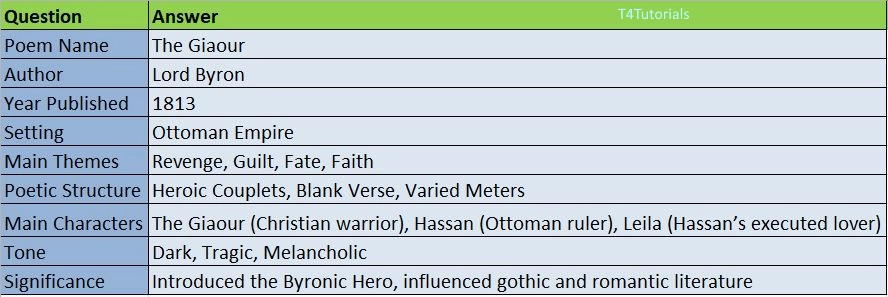
“The Giaour” is a narrative poem by Lord Byron, first published in 1813 as part of his Oriental Tales series. The title, Giaour, is a derogatory Turkish term for a non-Muslim or infidel. The poem is set in the Ottoman Empire and follows a fragmented, nonlinear storytelling structure.
The story revolves around Leila, a woman from the Ottoman ruler Hassan’s harem, who is executed for being unfaithful. Her lover, a Venetian Christian warrior known as the Giaour, avenges her death by killing Hassan. However, this act of revenge does not bring him peace, and he later retreats to a monastery, haunted by guilt and remorse. The poem explores themes of revenge, love, faith, fate, and existential despair.
Byron’s The Giaour introduced a new type of literary figure: the Byronic Hero, a brooding, passionate, rebellious, and often tormented character. The poem is written in heroic couplets, blank verse, and varied meters, giving it a dramatic and lyrical style.
1. : What does the word Giaour mean?
(A) A warrior
(B) An Ottoman ruler
(C) A non-Muslim or infidel
(D) A pirate
2. : Who is the author of The Giaour?
(A) William Wordsworth
(B) Lord Byron
(C) John Keats
(D) Percy Bysshe Shelley
3. : In which year was The Giaour published?
(A) 1810
(B) 1813
(C) 1816
(D) 1820
4. : What is the main theme of The Giaour?
(A) Romantic love
(B) The power of nature
(C) Revenge and guilt
(D) Political revolution
5. : Who is Leila in The Giaour?
(A) The mother of the protagonist
(B) The wife of Hassan
(C) The lover of the Giaour who is executed
(D) A goddess
6. : What happens to Hassan in the poem?
(A) He becomes a king
(B) He is killed by the Giaour
(C) He forgives the Giaour
(D) He marries Leila
7. : Where does the Giaour go after seeking revenge?
(A) To a monastery
(B) Back to Venice
(C) To another battle
(D) To the Ottoman court
8. : Which literary figure does The Giaour introduce?
(A) The Romantic Lover
(B) The Byronic Hero
(C) The Noble Savage
(D) The Tragic Fool
9. : What poetic structure is used in The Giaour?
(A) Sonnet form
(B) Blank verse and heroic couplets
(C) Haiku
(D) Free verse
10. : What emotion dominates the Giaour’s character after his revenge?
(A) Joy
(B) Regret and torment
(C) Indifference
(D) Pride