
Difference between Early binding and late binging
| Early binding | late binging |
| Order of Execution: 1st(Early binding) then 2nd (late binging) | |
| static binging | Dynamic Binding |
| Compile-time | Run time polymorphism |
| Matching of a function call with function definition is performed at compiler time. | Matching of a function call with function definition is performed at run time. |
| Full information about function calling and matching with function definition is visible to the compiler during compile time | Full information about function calling and matching with function definition is not visible to the compiler during compile time but it’s visible during run time. |
| More efficient: because the compiler already has knowledge that what code will execute | More flexible:
|
| Fast execution | Slow execution |
| Examples: Function overloading and operator overloading | Examples: Virtual functions |
Example of Early binding in C++
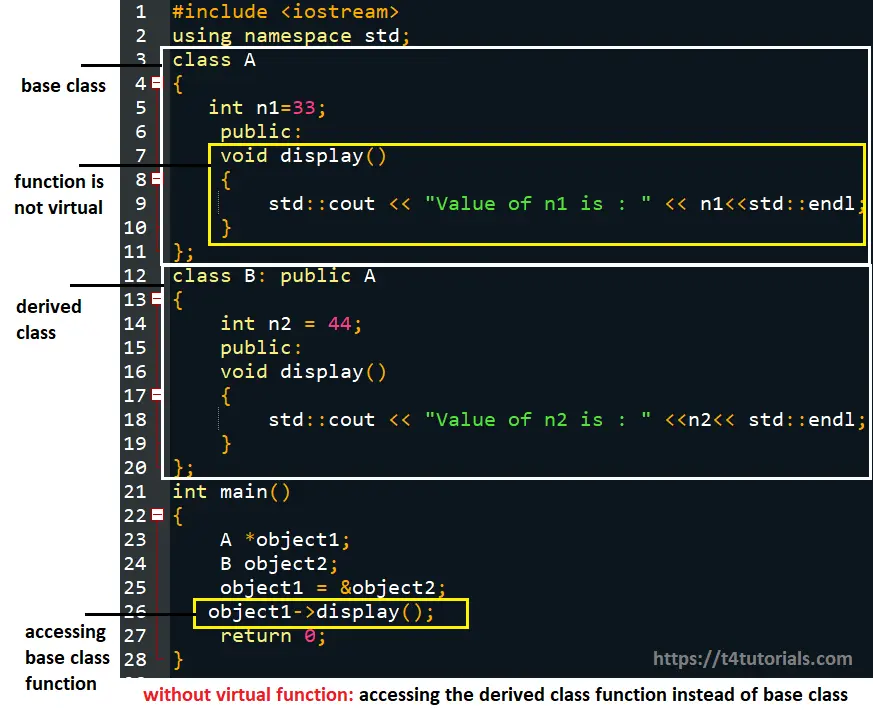
#include <iostream>
using namespace std;
class A
{
   int n1=33;
    public:
     void display()
    {
        std::cout << "Value of n1 is : " << n1<<std::endl;
    }
};
class B: public A
{
    int n2 = 44;
    public:
    void display()
    {
        std::cout << "Value of n2 is : " <<n2<< std::endl;
    }
};
int main()
{
    A *object1;
    B object2;
    object1 = &object2;
   object1->display();
    return 0;
}
Output
Value of n1 is : 33
Example of Late binding in C++
Late binding can be implemented by making a function as a virtual function.
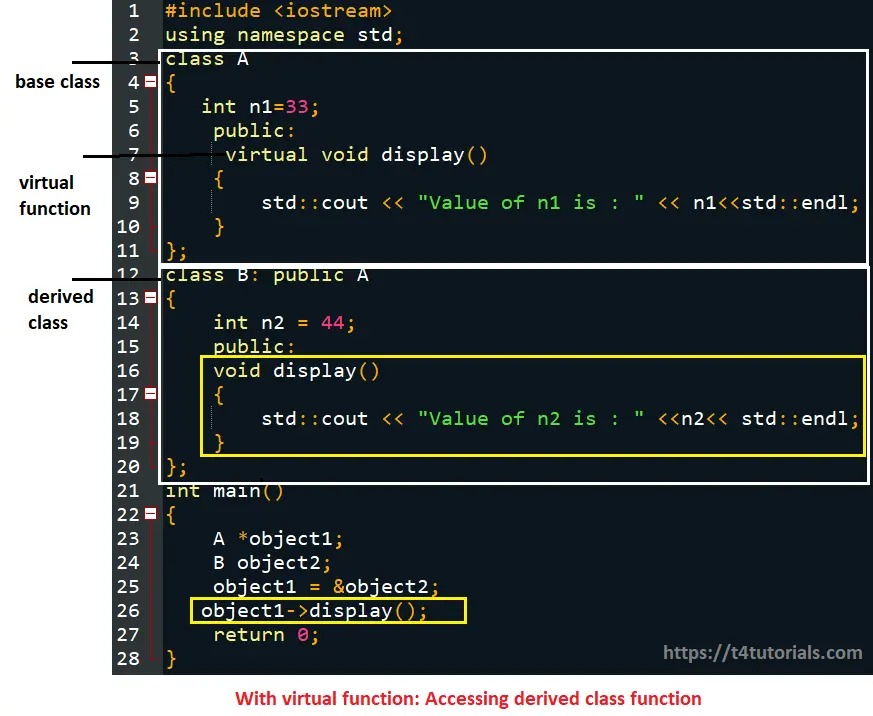
#include <iostream>
using namespace std;
class A
{
   int n1=33;
    public:
    virtual void display()
    {
        std::cout << "Value of n1 is : " << n1<<std::endl;
    }
};
class B: public A
{
    int n2 = 44;
    public:
    void display()
    {
        std::cout << "Value of n2 is : " <<n2<< std::endl;
    }
};
int main()
{
    A *object1;
    B object2;
    object1 = &object2;
   object1->display();
    return 0;
}
Output
Value of n2 is : 44