
Summary:
The Temple of Fame by Alexander Pope is an allegorical poem inspired by Geoffrey Chaucer’s The House of Fame. Written in heroic couplets, the poem presents a vision of Fame’s temple, where the reputations of historical and literary figures are judged. Pope explores the nature of fame, highlighting how it is often fleeting, subject to fortune, and influenced by personal virtue or vice. The poem critiques those who seek fame through dishonorable means and suggests that true fame comes from merit and moral excellence. It reflects Pope’s neoclassical ideals, emphasizing reason, justice, and virtue.
-
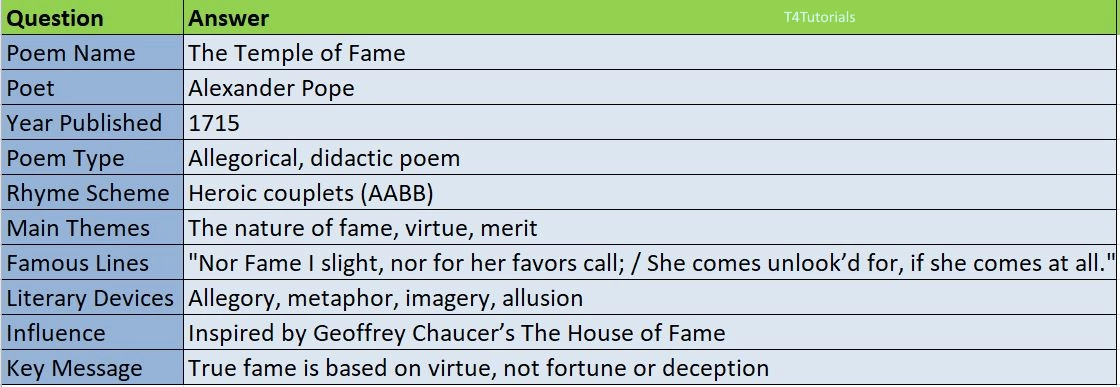
The Temple of Fame
1. : Who wrote The Temple of Fame?
(A) John Milton
(B) Geoffrey Chaucer
(C) Alexander Pope
(D) William Shakespeare
2. : What inspired The Temple of Fame?
(A) Virgil’s Aeneid
(B) Chaucer’s The House of Fame
(C) Homer’s Odyssey
(D) Dante’s Inferno
3. : What is the main theme of The Temple of Fame?
(A) The importance of wealth
(B) The pursuit and nature of fame
(C) The downfall of empires
(D) The corruption of the church
4. : What poetic form is The Temple of Fame written in?
(A) Blank verse
(B) Sonnet
(C) Heroic couplets
(D) Free verse
5. : According to Pope, what determines true fame?
(A) Political power
(B) Wealth and inheritance
(C) Personal merit and virtue
(D) Flattery and deception
6. : What does Pope criticize in The Temple of Fame?
(A) The decline of monarchy
(B) The fleeting and arbitrary nature of fame
(C) The lack of scientific progress
(D) The influence of religion in politics
7. : Which literary device is commonly used in The Temple of Fame?
(A) Satire
(B) Metaphor
(C) Hyperbole
(D) Paradox
8. : What kind of figures does Pope mention in The Temple of Fame?
(A) Kings and queens only
(B) Poets, philosophers, and rulers
(C) Farmers and commoners
(D) Mythological creatures
9. : What is the setting of The Temple of Fame?
(A) A royal palace
(B) A mystical temple where fame is judged
(C) A battlefield
(D) A deserted island
10. : What is the tone of The Temple of Fame?
(A) Playful and humorous
(B) Reflective and moralizing
(C) Dark and tragic
(D) Romantic and emotional