
Summary:
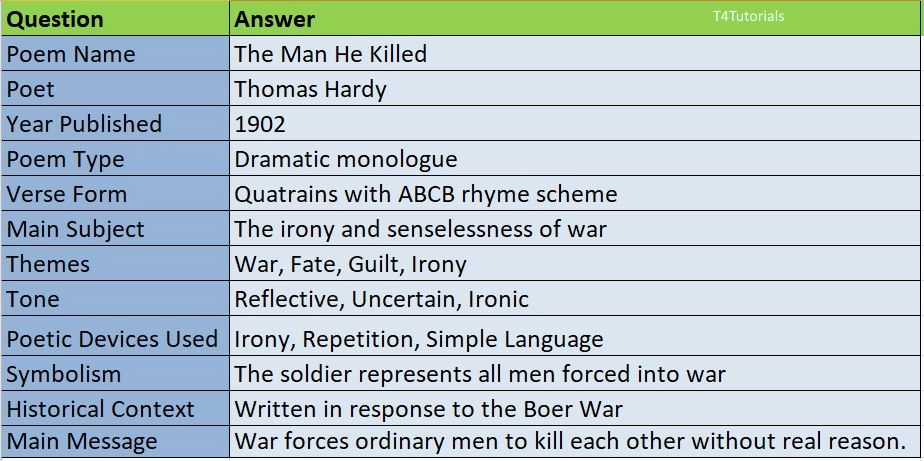
Thomas Hardy’s The Man He Killed is a dramatic monologue that explores the irony and senselessness of war. The speaker, a soldier, reflects on how he killed an enemy in battle—someone who, under different circumstances, he might have shared a drink with. The poem highlights the absurdity of war, where men who have no personal grievances against each other are forced to fight and kill. Hardy uses simple language and an ironic tone to emphasize the tragic consequences of blind duty and war’s illogical nature.
1. : Who wrote The Man He Killed?
(A) Wilfred Owen
(B) T.S. Eliot
(C) Thomas Hardy
(D) Robert Frost
2. : What is the poem’s main theme?
(A) The glory of war
(B) The absurdity of war
(C) The joy of victory
(D) The heroism of soldiers
3. : How does the soldier feel about killing his enemy?
(A) Proud and victorious
(B) Indifferent
(C) Conflicted and uneasy
(D) Joyful
4. : What poetic form is used in The Man He Killed?
(A) Sonnet
(B) Free verse
(C) Dramatic monologue
(D) Haiku
5. : Which literary device is most prominent in the poem?
(A) Simile
(B) Irony
(C) Metaphor
(D) Alliteration
6. : What does the speaker say he and the enemy soldier might have done in a different situation?
(A) Become enemies anyway
(B) Had a drink together
(C) Ignored each other
(D) Traveled together
7. : What does the repetition of the word “because” in the poem suggest?
(A) The speaker is certain about his actions
(B) The speaker is trying to justify his actions but is unsure
(C) The speaker is angry at his enemy
(D) The speaker is celebrating his victory
8. : Why did the speaker shoot the man?
(A) Because they were on opposite sides in war
(B) Because he hated him
(C) Because he wanted revenge
(D) Because the enemy attacked him first
9. : What is the rhyme scheme of the poem?
(A) ABAB
(B) AABB
(C) ABCB
(D) AAAB
10. : How does Hardy portray war in the poem?
(A) As a noble cause
(B) As an unnecessary and illogical event
(C) As a thrilling adventure
(D) As a test of courage
11. : What tone does the speaker use throughout the poem?
(A) Triumphant
(B) Bitter
(C) Reflective and uncertain
(D) Excited
12. : Why does Hardy use informal, conversational language in the poem?
(A) To make it more dramatic
(B) To show the speaker’s casual attitude toward war
(C) To make it relatable and emphasize the everyday nature of war
(D) To confuse the reader
13. : What does the poem suggest about the soldiers on both sides of a war?
(A) They are enemies by nature
(B) They are forced into conflict by circumstance
(C) They are always proud of their duty
(D) They are completely different from each other
14. : What is ironic about the soldier’s justification for killing?
(A) He thinks killing is always justified
(B) He acknowledges that he had no real reason to kill the man
(C) He believes he will be rewarded for his actions
(D) He does not care about what he did
15. : What is the historical context of the poem?
(A) The American Civil War
(B) The Napoleonic Wars
(C) The Boer War
(D) World War I