
1. Who wrote The Faerie Queene?
(A) John Milton
(B) Geoffrey Chaucer
(C) Edmund Spenser
(D) Philip Sidney
2. The Faerie Queene was first published in which year?
(A) 1589
(B) 1590
(C) 1596
(D) 1600
3. How many books of The Faerie Queene did Spenser complete?
(A) Four
(B) Seven
(C) Eight
(D) Six
4. The poem The Faerie Queene was written to honor which monarch?
(A) Queen Mary I
(B) Queen Elizabeth I
(C) King James I
(D) Henry VIII
5. What poetic form did Spenser invent for The Faerie Queene?
(A) Spenserian stanza
(B) Ottava rima
(C) Heroic couplet
(D) Blank verse
6. Each Spenserian stanza contains how many lines?
(A) Eight
(B) Ten
(C) Nine
(D) Twelve
7. The rhyme scheme of the Spenserian stanza is:
(A) ababbcbcc
(B) ababccdde
(C) aabbccdde
(D) abababcc
8. The Red Cross Knight represents which virtue?
(A) Temperance
(B) Holiness
(C) Chastity
(D) Courage
9. Who accompanies the Red Cross Knight on his journey?
(A) Britomart
(B) Belphoebe
(C) Duessa
(D) Una
10. What does Una symbolize?
(A) Falsehood
(B) True religion and truth
(C) Deceit
(D) Knowledge
11. Who is the main villain deceiving the Red Cross Knight?
(A) Malbecco
(B) Guyon
(C) Archimago
(D) Florimell
12. Duessa symbolizes:
(A) Truth
(B) Falsehood and duplicity
(C) Hope
(D) Strength
13. The dragon slain by the Red Cross Knight represents:
(A) Sin
(B) Death
(C) Pride
(D) Satan
14. Prince Arthur symbolizes the virtue of:
(A) Justice
(B) Fortitude
(C) Magnificence
(D) Temperance
15. In Book II, the hero Sir Guyon stands for which virtue?
(A) Justice
(B) Temperance
(C) Chastity
(D) Friendship
16. The central virtue of Book III is:
(A) Chastity
(B) Courtesy
(C) Justice
(D) Friendship
17. Britomart, the heroine of Book III, is a symbol of:
(A) Friendship
(B) Chastity
(C) Courage
(D) Truth
18. The House of Pride represents:
(A) Virtue
(B) Humility
(C) Sin and moral corruption
(D) Justice
19. The character of Gloriana in The Faerie Queene stands for:
(A) Truth
(B) Wisdom
(C) Faith
(D) Queen Elizabeth I and glory
20. The Faerie Queene was intended as an allegory of:
(A) Classical mythology
(B) Christian morality and Elizabethan virtue
(C) Roman history
(D) Pagan heroism
Summary:
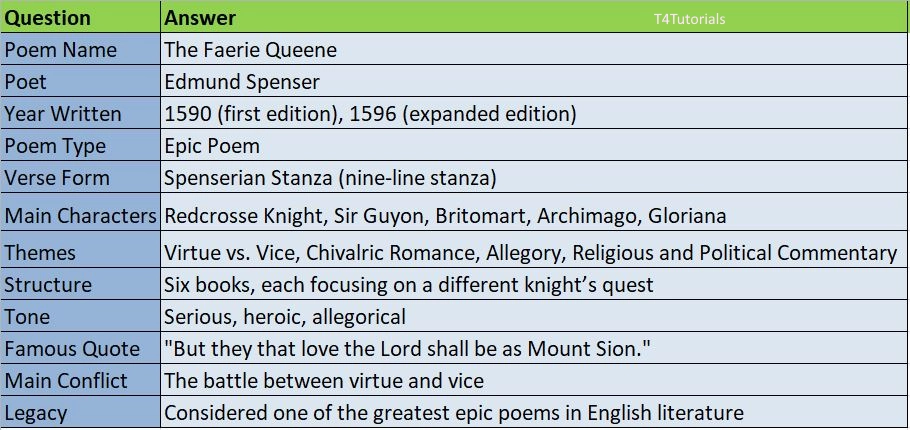
The Faerie Queene is an epic poem written by Edmund Spenser, first published in 1590 and expanded in 1596. It tells the story of a series of knights, each representing a different virtue, who undertake heroic quests to uphold righteousness in a mythical world. The central figure, Redcrosse Knight, represents holiness, and his journey is an allegorical representation of the Christian struggle for salvation. Throughout the poem, the knights confront various temptations and challenges that symbolize the virtues and vices of human nature. The poem also explores themes of chivalry, religious righteousness, and political allegory, as Spenser subtly addresses the tensions of the Protestant Reformation in England.
The poem is divided into six books, each focusing on a particular knight’s quest. While Redcrosse Knight’s tale of holiness is central, other knights such as Sir Guyon, who represents temperance, and Britomart, who represents chastity, also undertake their respective quests. Through allegory and detailed descriptions, Spenser creates a vivid portrayal of an idealized world where virtue triumphs over vice, and the knights emerge victorious in their endeavors.
1. : Who is the central protagonist in The Faerie Queene?
(A) Sir Guyon
(B) Redcrosse Knight
(C) Britomart
(D) Archimago
2. : Which virtue does Redcrosse Knight represent in The Faerie Queene?
(A) Courage
(B) Chastity
(C) Holiness
(D) Temperance
3. : What does Sir Guyon represent in The Faerie Queene?
(A) Chastity
(B) Courage
(C) Justice
(D) Temperance
4. : What is the primary setting of The Faerie Queene?
(A) The city of London
(B) A mystical, fairy-tale realm
(C) Ancient Greece
(D) A medieval castle
5. : Which character in The Faerie Queene symbolizes chastity?
(A) Sir Guyon
(B) Redcrosse Knight
(C) Britomart
(D) Archimago
6. : What is the theme of The Faerie Queene?
(A) The conflict between love and hate
(B) The triumph of virtue over vice
(C) The fall of a great kingdom
(D) A romantic tragedy
7. : What kind of literary work is The Faerie Queene?
(A) Sonnet cycle
(B) Epic poem
(C) Tragedy
(D) Comedy
8. : What is the main conflict in The Faerie Queene?
(A) The knights’ pursuit of their respective virtues
(B) A war between kingdoms
(C) A dispute over inheritance
(D) The fall of an empire
9. : Who does Archimago represent in The Faerie Queene?
(A) Virtue
(B) Falsehood
(C) Chastity
(D) Courage
10. : How many books are there in The Faerie Queene?
(A) 4
(B) 6
(C) 12
(D) 9