
Summary:
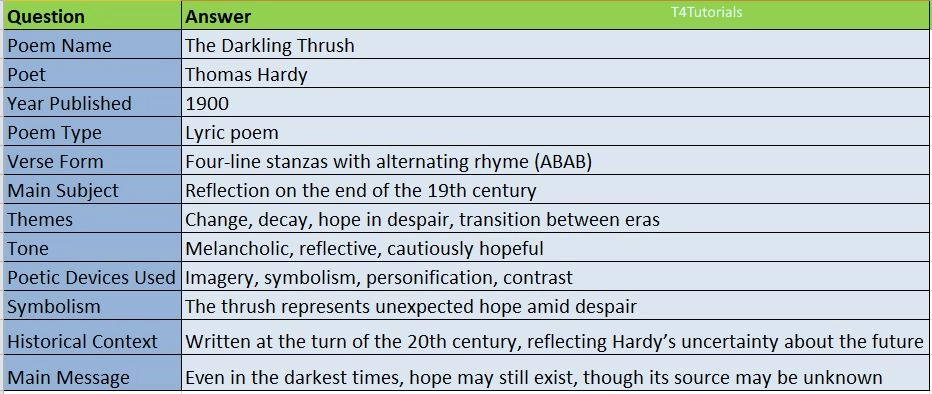
Thomas Hardy’s The Darkling Thrush (1900) is a contemplative poem that reflects on the end of the 19th century and the uncertainties of the future. The poem is set in a bleak winter landscape, symbolizing death, decay, and the fading of old traditions. The speaker, surrounded by desolation, feels a sense of hopelessness. However, amidst this gloom, a frail and aged thrush unexpectedly sings a joyful song. The contrast between the dreary setting and the bird’s hopeful melody highlights the theme of optimism in despair. Hardy suggests that, even in dark times, there may be a source of hope—though it might not be fully understood by the observe.
1. : Who is the poet of The Darkling Thrush?
(A) William Wordsworth
(B) Robert Frost
(C) Thomas Hardy
(D) John Keats
2. : In which year was The Darkling Thrush written?
(A) 1885
(B) 1890
(C) 1900
(D) 1915
3. : What is the main theme of the poem?
(A) The joy of spring
(B) The beauty of nature
(C) The passage of time and hope in despair
(D) The impact of war
4. : What is the setting of the poem?
(A) A bright summer morning
(B) A gloomy winter evening
(C) A rainy autumn afternoon
(D) A foggy spring dawn
5. : What does the thrush’s song symbolize?
(A) The arrival of spring
(B) The end of happiness
(C) Unexpected hope in difficult times
(D) The loneliness of the speaker
6. : Which literary device is prominently used in The Darkling Thrush?
(A) Hyperbole
(B) Satire
(C) Imagery and symbolism
(D) Pun
7. : How does the speaker feel at the beginning of the poem?
(A) Joyful and hopeful
(B) Lonely and despondent
(C) Angry and frustrated
(D) Indifferent and passive
8. : What does the landscape in the poem symbolize?
(A) The beauty of winter
(B) The decline of old traditions and uncertainty about the future
(C) The excitement of the new century
(D) The power of nature over humans
9. : What contrast is presented in the poem?
(A) Youth vs. old age
(B) Desolation vs. unexpected hope
(C) Love vs. hate
(D) Nature vs. industrialization
10. : What is the tone of the poem?
(A) Purely optimistic
(B) Completely tragic
(C) Initially gloomy but shifts towards cautious hope
(D) Mocking and humorous