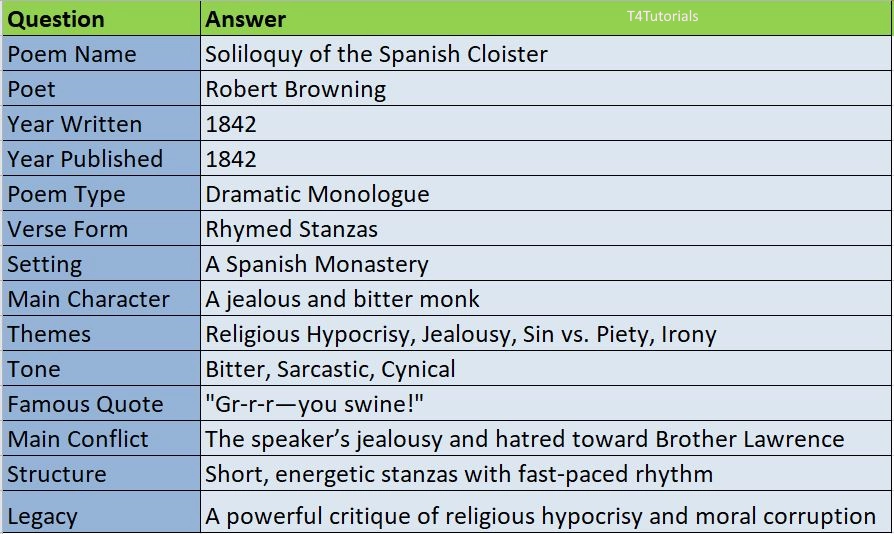
1. What is the form of “Soliloquy of the Spanish Cloister”?
(A) Sonnet
(B) Dramatic Monologue
(C) Free Verse
(D) Epic Poem
2. Who is the speaker in the poem?
(A) Brother Lawrence
(B) A priest
(C) A jealous monk
(D) A traveler
3. What is the speaker’s attitude toward Brother Lawrence?
(A) Admiration
(B) Indifference
(C) Friendship
(D) Jealousy and hatred
4. What does the speaker accuse Brother Lawrence of?
(A) Being a thief
(B) Hypocrisy and hidden sins
(C) Practicing witchcraft
(D) Lying about his past
5. How does the speaker try to discredit Brother Lawrence?
(A) By trying to tempt him into sin
(B) By spreading rumors about him
(C) By reporting him to the church authorities
(D) By challenging him to a debate
6. What is ironic about the speaker’s accusations?
(A) Brother Lawrence is actually a good person
(B) The speaker is guilty of worse sins than Brother Lawrence
(C) The speaker secretly admires Brother Lawrence
(D) The accusations are completely imaginary
7. What literary device is most commonly used in the poem?
(A) Simile
(B) Personification
(C) Hyperbole
(D) Irony
8. What does the speaker wish to happen to Brother Lawrence?
(A) That he gets expelled from the monastery
(B) That he dies
(C) That he falls into sin and goes to hell
(D) That he becomes a famous priest
9. What does the poem critique?
(A) The corruption within the Catholic Church
(B) The hypocrisy in religious institutions
(C) The lack of faith in monks
(D) The decline of monastic life
10. What is the tone of the poem?
(A) Serious and tragic
(B) Lighthearted and humorous
(C) Bitter and sarcastic
(D) Romantic and emotional
Summary:
Robert Browning’s “Soliloquy of the Spanish Cloister” is a dramatic monologue written in 1842, featuring a bitter and jealous monk who despises his fellow monk, Brother Lawrence. The speaker, who remains unnamed, mocks Brother Lawrence’s seemingly pious behavior and accuses him of hypocrisy, all while revealing his own sinful and envious nature. Through his sarcastic and spiteful remarks, the speaker exposes the darker side of religious life, where personal rivalries and moral corruption exist beneath a surface of devotion. The poem explores themes of hypocrisy, religious jealousy, and moral corruption, using energetic language, irony, and a dramatic, almost theatrical tone.