
Summary:
“So, We’ll Go No More a Roving” is a short but deeply reflective poem by Lord Byron, written in 1817 during his stay in Venice and later published in 1830 after his death. The poem explores themes of aging, fatigue, and the passage of time, suggesting that the youthful days of endless wandering and pleasure must come to an end.
Byron uses the metaphor of “roving” (wandering or partying) to represent the carefree and passionate lifestyle of youth. However, he acknowledges that the heart and soul, like the moon in the sky, need rest and renewal. Despite the desire to continue, the weariness of the body and spirit forces a pause.
The poem is composed of three quatrains (four-line stanzas) with an ABAB rhyme scheme, which gives it a lyrical and musical quality. The tone is nostalgic and melancholic, reflecting a moment of self-realization that even the most passionate pursuits must eventually slow down.
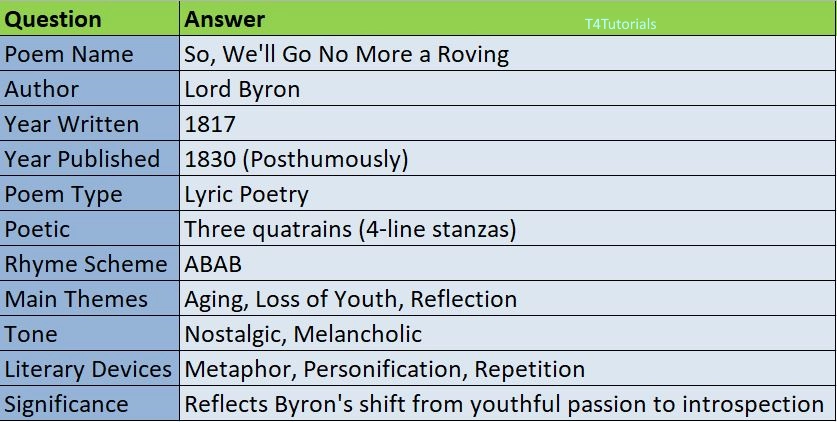
1. : What is the central theme of So, We’ll Go No More a Roving?
(A) Adventure and discovery
(B) The end of youthful pleasures and the passage of time
(C) The joy of travel
(D) The beauty of nature
2. : Who wrote So, We’ll Go No More a Roving?
(A) Percy Bysshe Shelley
(B) William Wordsworth
(C) John Keats
(D) Lord Byron
3. : When was the poem written?
(A) 1808
(B) 1817
(C) 1824
(D) 1830
4. : When was the poem published?
(A) 1816
(B) 1818
(C) 1830
(D) 1822
5. : What does the phrase “so, we’ll go no more a roving” mean?
(A) The speaker is tired of traveling
(B) The speaker is ending a romantic relationship
(C) The speaker is realizing that youthful pleasures must end
(D) The speaker is leaving his home forever
6. : What does the poet compare the heart to?
(A) A wandering star
(B) A moon that still shines
(C) A tired warrior
(D) A restless sea
7. : What is the rhyme scheme of the poem?
(A) ABAB
(B) AABB
(C) ABCD
(D) AAAB
8. : Which literary device is used in “Though the night was made for loving”?
(A) Personification
(B) Simile
(C) Hyperbole
(D) Alliteration
9. : What is the tone of the poem?
(A) Hopeful and joyful
(B) Nostalgic and melancholic
(C) Angry and regretful
(D) Excited and adventurous
10. : What does the poet imply about human desires?
(A) They never end
(B) They must be controlled with time
(C) They always lead to happiness
(D) They are meaningless