
Summary:
“Porphyria’s Lover” is a dramatic monologue written by Robert Browning. In this poem, the speaker, a lover, recounts an evening spent with his lover, Porphyria, who arrives at his cottage during a storm. As she makes the fire burn brighter and shows affection towards him, the lover, overwhelmed by a sense of control and power, strangles her with her own hair to “preserve” the perfect moment of love. The poem explores themes of obsession, control, and madness, with the speaker justifying his crime by the belief that Porphyria would have wanted him to kill her to keep her love forever.
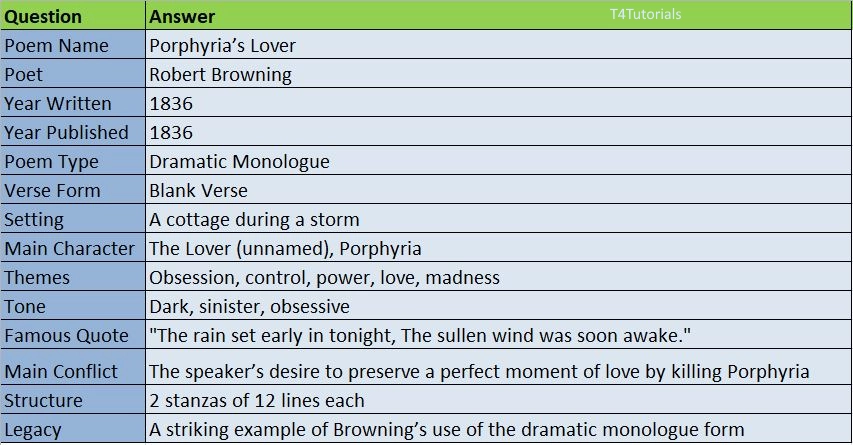
1. : What action does the speaker take in Porphyria’s Lover?
(A) He kisses Porphyria
(B) He strangles Porphyria
(C) He proposes to Porphyria
(D) He leaves Porphyria
2. : How does the speaker describe Porphyria’s hair in Porphyria’s Lover?
(A) As a symbol of her beauty
(B) As a weapon
(C) As a symbol of her love
(D) As a symbol of power
3. : Where does the poem Porphyria’s Lover take place?
(A) In a garden
(B) In a cottage
(C) In a castle
(D) In a church
4. : What is the speaker’s justification for killing Porphyria in Porphyria’s Lover?
(A) He wants revenge
(B) He wants to keep her love forever
(C) He is angry with her
(D) He is protecting her
5. : What emotion does the speaker primarily feel towards Porphyria in the poem?
(A) Anger
(B) Desperation
(C) Control and obsession
(D) Happiness
6. : What type of poem is Porphyria’s Lover?
(A) Sonnet
(B) Dramatic monologue
(C) Free verse
(D) Ballad
7. : What is the mood of Porphyria’s Lover?
(A) Peaceful
(B) Sad
(C) Dark and sinister
(D) Joyful
8. : How does the speaker view his actions at the end of the poem?
(A) As a mistake
(B) As a self-sacrifice
(C) As a way of keeping Porphyria’s love forever
(D) As a form of revenge
9. : What literary technique is primarily used in Porphyria’s Lover to present the speaker’s thoughts?
(A) Allegory
(B) Imagery
(C) Dramatic monologue
(D) Paradox