
Summary:
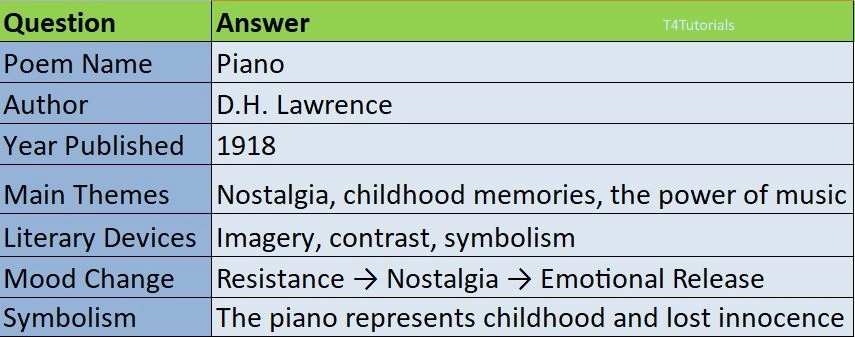
“Piano” is a poem by D.H. Lawrence that explores themes of nostalgia, childhood memories, and the emotional power of music. The speaker hears a woman singing and is transported back to his childhood, where he remembers sitting under the piano while his mother played. The memory is vivid and deeply emotional, evoking a sense of longing for the past.
As the poem progresses, the speaker struggles between his present self and the overwhelming emotions from his childhood. Despite trying to resist, he is overcome by nostalgia, leading him to tears. The poem highlights the bittersweet nature of memories and how music has the power to unlock deep, hidden emotions. Lawrence uses imagery, contrast, and a melancholic tone to convey the depth of the speaker’s feelings.
1. : Who is the author of Piano?
(A) William Blake
(B) D.H. Lawrence
(C) Robert Frost
(D) John Keats
2. : What triggers the speaker’s memories in the poem?
(A) The sight of an old piano
(B) A childhood photograph
(C) The sound of a woman singing
(D) A conversation about childhood
3. : What does the speaker remember from his childhood?
(A) His father telling stories
(B) Sitting under the piano while his mother played
(C) Playing with his siblings in the garden
(D) Attending a music concert
4. : What is the central theme of the poem?
(A) The power of music and nostalgia
(B) The fear of growing old
(C) The struggle between love and loss
(D) The beauty of nature
5. : How does the speaker feel about his memories?
(A) Happy and joyful
(B) Indifferent and detached
(C) Overwhelmed with emotion and longing
(D) Angry and frustrated
6. : What is the tone of the poem?
(A) Joyful and celebratory
(B) Melancholic and nostalgic
(C) Hopeful and inspiring
(D) Fearful and suspenseful
7. : What literary device is prominently used in the poem?
(A) Simile
(B) Hyperbole
(C) Imagery
(D) Alliteration
8. : What does the piano symbolize in the poem?
(A) The burden of adulthood
(B) The speaker’s lost childhood and innocence
(C) The power of dreams
(D) The fear of the unknown
9. : Why does the speaker resist his emotions at first?
(A) He dislikes music
(B) He doesn’t want to appear weak
(C) He fears forgetting his childhood
(D) He is angry at his past
10. : What happens to the speaker by the end of the poem?
(A) He fully embraces his emotions and weeps
(B) He forgets his childhood memories
(C) He becomes angry at the woman singing
(D) He leaves before the song ends