
Summary:
In Of Adversity, Francis Bacon argues that adversity, though difficult, is essential for growth, wisdom, and moral strength. He contrasts prosperity, which he believes weakens individuals, with adversity, which strengthens character and virtue. Bacon refers to Seneca and early Christian martyrs as examples of those who gained spiritual and moral strength through suffering. He also emphasizes that adversity strengthens faith and makes people appreciate life’s deeper meanings. While prosperity may bring material comfort, adversity builds resilience and wisdom, shaping great leaders and thinkers. Bacon concludes that adversity is not to be feared but embraced as a path to greater virtue.
1. : What is the main theme of Bacon’s essay Of Adversity?
(A) The disadvantages of suffering
(B) The benefits and wisdom gained from adversity
(C) The role of luck in adversity
(D) How to avoid adversity
2. : According to Bacon, which type of life does he consider more virtuous?
(A) A life of prosperity
(B) A life of adversity
(C) A life without challenges
(D) A life of extreme wealth
3. : What does Bacon compare adversity to in his essay?
(A) A storm that destroys everything
(B) A dark night before a bright day
(C) A tough but useful teacher
(D) A disease with no cure
4. : Which classical philosopher does Bacon refer to when discussing adversity?
(A) Aristotle
(B) Seneca
(C) Plato
(D) Socrates
5. : What does Bacon say about prosperity in comparison to adversity?
(A) Prosperity is better than adversity in all aspects
(B) Prosperity makes people weak, while adversity strengthens them
(C) Prosperity leads to wisdom and good decisions
(D) Adversity should be completely avoided
6. : What religious reference does Bacon use to support his views on adversity?
(A) The Ten Commandments
(B) The sufferings of early Christian martyrs
(C) The story of Adam and Eve
(D) The teachings of Jesus on love
7. : How does Bacon view adversity in relation to human character?
(A) It weakens the mind and body
(B) It builds strength, virtue, and wisdom
(C) It brings no benefits
(D) It should be feared and avoided
8. : What does Bacon say about adversity’s effect on faith and religion?
(A) It weakens religious belief
(B) It strengthens faith and moral values
(C) It has no impact on religion
(D) It leads people to question God
9. : What does Bacon say about the role of adversity in history?
(A) It has destroyed civilizations
(B) It has produced great leaders and thinkers
(C) It is irrelevant to historical progress
(D) It has always been feared by societies
10. : What is the final message of Of Adversity?
(A) Adversity should be avoided at all costs
(B) Adversity is a necessary experience that leads to wisdom and virtue
(C) Prosperity is always better than adversity
(D) Life should be without suffering
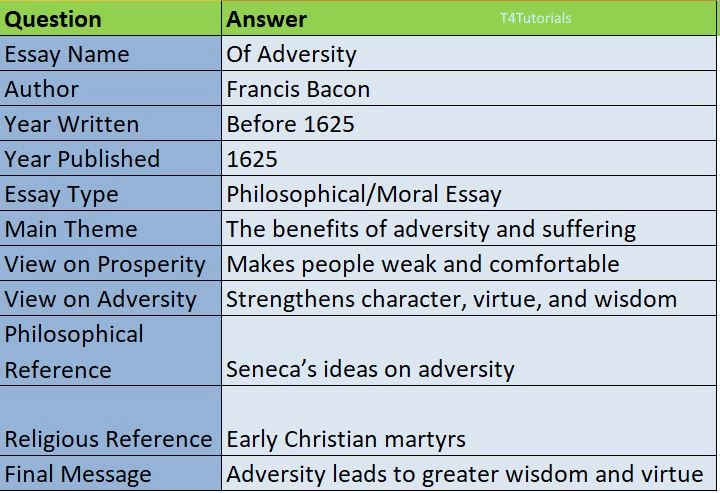
| Question | Answer |
| Essay Name | Of Adversity |
| Author | Francis Bacon |
| Year Written | Before 1625 |
| Year Published | 1625 |
| Essay Type | Philosophical/Moral Essay |
| Main Theme | The benefits of adversity and suffering |
| View on Prosperity | Makes people weak and comfortable |
| View on Adversity | Strengthens character, virtue, and wisdom |
| Philosophical Reference | Seneca’s ideas on adversity |
| Religious Reference | Early Christian martyrs |
| Final Message | Adversity leads to greater wisdom and virtue |