Summary:
William Wordsworth’s Ode: Intimations of Immortality from Recollections of Early Childhood explores the poet’s deep reflections on the passage of time and the loss of childhood innocence. The poem expresses a nostalgic longing for the pure and divine vision of the world that children naturally possess. Wordsworth suggests that in childhood, humans are closer to the divine realm, but as they grow older, they lose this spiritual connection.
Despite this loss, the poet finds comfort in the idea that maturity brings a deeper philosophical understanding of life, memory, and nature’s enduring beauty. He acknowledges that while he can no longer experience nature with the same youthful wonder, he can still appreciate it through the wisdom gained over time. The poem ultimately conveys a message of reconciliation, balancing the sorrow of lost innocence with the joy of spiritual growth and insight.
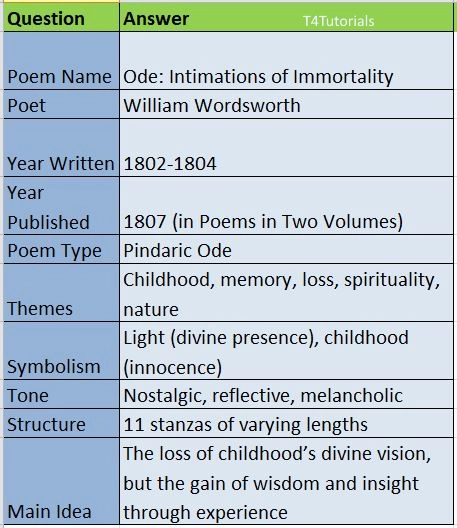
| Question | Answer |
| Poem Name | Ode: Intimations of Immortality |
| Poet | William Wordsworth |
| Year Written | 1802-1804 |
| Year Published | 1807 (in Poems in Two Volumes) |
| Poem Type | Pindaric Ode |
| Themes | Childhood, memory, loss, spirituality, nature |
| Symbolism | Light (divine presence), childhood (innocence) |
| Tone | Nostalgic, reflective, melancholic |
| Structure | 11 stanzas of varying lengths |
| Main Idea | The loss of childhood’s divine vision, but the gain of wisdom and insight through experience |
1. : What is the central theme of the poem “Ode: Intimations of Immortality”?
(A) The passage of time and loss of childhood innocence
(B) The beauty of the natural world
(C) The importance of religious devotion
(D) The struggles of human labor
2. : What does Wordsworth mean by “intimations of immortality”?
(A) A fear of death
(B) A belief that childhood memories remind us of a divine existence before birth
(C) A reference to life after death
(D) A philosophical argument against nature
3. : What causes the poet’s sadness in the poem?
(A) The loss of his youthful ability to see nature with wonder
(B) The death of a close friend
(C) The destruction of nature
(D) The hardships of adult life
4. : How does Wordsworth describe childhood in the poem?
(A) As a time of ignorance
(B) As a period when the soul is closest to heaven
(C) As a struggle between joy and sorrow
(D) As a meaningless phase of life
5. : What imagery does the poet use to describe the loss of childhood vision?
(A) A setting sun
(B) A fading dream
(C) A cloudy sky
(D) A broken mirror
6. : According to Wordsworth, what compensates for the loss of childhood wonder?
(A) The development of philosophical and spiritual insight
(B) The distractions of adult life
(C) The pursuit of wealth and status
(D) The return to childhood memories
7. : What does the poem suggest about the connection between childhood and the divine?
(A) Children have a direct connection to the spiritual world
(B) Childhood is a time of foolishness and ignorance
(C) The divine is only accessible through religious rituals
(D) There is no connection between childhood and spirituality
8. : What is the tone of the poem?
(A) Angry and rebellious
(B) Joyful and humorous
(C) Reflective and nostalgic
(D) Pessimistic and hopeless