
1. What is the main theme of Muiopotmos?
(A) Political intrigue
(B) The fragility of life and fate
(C) Urban corruption
(D) Religious devotion
2. Who is the central character of the poem?
(A) The butterfly named Clarion
(B) The king of fairies
(C) A young knight
(D) A shepherd
3. What literary form does Spenser use in Muiopotmos?
(A) Lyric poem
(B) Allegorical poem in Spenserian stanza
(C) Epic narrative
(D) Pastoral eclogue
4. What happens to Clarion in the poem?
(A) It escapes to a magical land
(B) It becomes a queen
(C) It dies tragically
(D) It defeats its enemies
5. Which literary device is heavily used in the poem?
(A) Dialogue
(B) Epic simile
(C) Satire
(D) Allegory and personification
6. What does the poem suggest about the natural world?
(A) It is fragile and subject to fate
(B) It is chaotic and threatening
(C) It is irrelevant to human life
(D) It is a political symbol
7. How does Spenser reflect Renaissance ideals in the poem?
(A) Through political commentary
(B) Through warfare imagery
(C) Through the beauty of nature and moral lessons
(D) Through historical events
8. What is the tone of Muiopotmos?
(A) Humorous
(B) Tragic and reflective
(C) Joyful and celebratory
(D) Satirical
9. Which creatures appear besides the butterfly?
(A) Kings and knights
(B) Mythical gods
(C) Sailors and merchants
(D) Various insects and fairies
10. What is the purpose of Muiopotmos?
(A) To describe warfare
(B) To record historical events
(C) To entertain and teach a moral lesson about life’s fragility
(D) To critique political leaders
Summary:
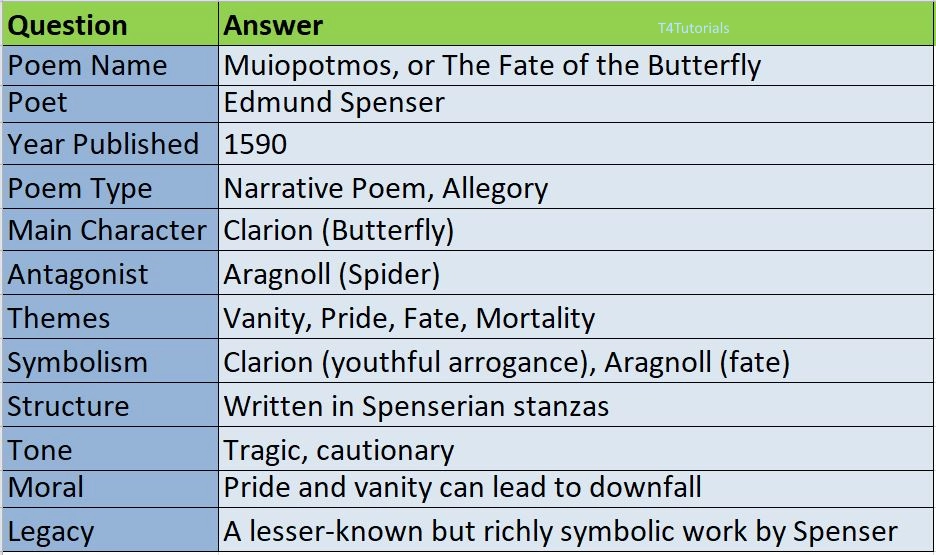
Muiopotmos, or The Fate of the Butterfly is a narrative poem by Edmund Spenser, written in 1590. The poem tells the tragic story of a beautiful butterfly named Clarion, who is born into a luxurious and privileged life. Despite his beauty and grace, Clarion becomes prideful and careless, indulging in vanity and pleasure rather than caution.
One day, while enjoying his surroundings, he is caught in a spider’s web, woven by the cunning and predatory spider Aragnoll. The poem describes in vivid detail how Clarion, despite his beauty and speed, is ultimately trapped and killed by the spider.
The poem is often interpreted as an allegory for the dangers of pride, vanity, and the unpredictable nature of fate. It also reflects Renaissance humanist ideas, warning against overindulgence in worldly pleasures.
1. : What does the title Muiopotmos mean?
(A) The Victory of the Butterfly
(B) The Fate of the Butterfly
(C) The Journey of the Butterfly
(D) The Flight of the Butterfly
2. : Who is the main character of the poem?
(A) Aragnoll
(B) Clarion
(C) Redcrosse Knight
(D) Colin Clout
3. : What kind of creature is Clarion?
(A) A bee
(B) A butterfly
(C) A moth
(D) A bird
4. : What is the main flaw of Clarion?
(A) Wisdom
(B) Cunning
(C) Pride and vanity
(D) Bravery
5. : What happens to Clarion at the end of the poem?
(A) He escapes the spider’s web
(B) He is trapped and killed by Aragnoll
(C) He becomes king of the butterflies
(D) He transforms into a bird
6. : Who is Aragnoll in the poem?
(A) A wise old butterfly
(B) A spider who traps Clarion
(C) A noble knight
(D) A bird that helps Clarion
7. : What literary device is most prominent in the poem?
(A) Allegory
(B) Satire
(C) Epic simile
(D) Parody
8. : What is a major theme of the poem?
(A) The beauty of nature
(B) The importance of adventure
(C) The dangers of vanity and pride
(D) The power of love
9. : What does the spider Aragnoll symbolize?
(A) Strength and wisdom
(B) Fate and inevitable doom
(C) Justice and fairness
(D) The joys of life
10. : How does Muiopotmos fit within Edmund Spenser’s literary style?
(A) It is a dramatic play
(B) It follows the tradition of Renaissance allegorical poetry
(C) It is a scientific essay
(D) It is a political manifesto