
Summary:
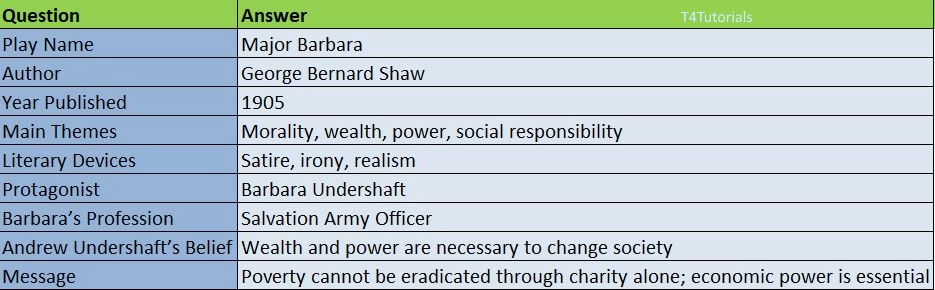
Major Barbara is a play written by George Bernard Shaw in 1905. It explores themes of morality, wealth, power, and social responsibility through the story of Barbara Undershaft, a devoted officer in the Salvation Army, and her father, Andrew Undershaft, a wealthy munitions manufacturer.
Barbara believes in helping the poor through charity and faith, while her father argues that real power and change come from money and industry. When the Salvation Army accepts donations from wealthy industrialists, including Undershaft, Barbara becomes disillusioned, realizing that poverty cannot be eradicated through charity alone.
The play challenges traditional views on morality, questioning whether wealth gained from war and industry is inherently evil or if it can be used for good. By the end, Barbara begins to see her father’s perspective—that economic power is necessary for true social change.
1. : Who wrote Major Barbara?
(A) William Shakespeare
(B) George Bernard Shaw
(C) Oscar Wilde
(D) Henrik Ibsen
2. : In which year was Major Barbara published?
(A) 1900
(B) 1905
(C) 1910
(D) 1913
3. : What is Barbara Undershaft’s role in the Salvation Army?
(A) General
(B) Officer
(C) Volunteer
(D) Treasurer
4. : What is Andrew Undershaft’s profession?
(A) A politician
(B) A businessman
(C) A munitions manufacturer
(D) A military general
5. : What is Barbara’s moral conflict in the play?
(A) She struggles between her love for religion and her duty to her family
(B) She is torn between charity and the power of wealth
(C) She does not want to marry
(D) She wants to join the army instead of the Salvation Army
6. : Why does Barbara become disillusioned with the Salvation Army?
(A) They expel her for her beliefs
(B) They accept donations from wealthy industrialists, including her father
(C) They refuse to help the poor
(D) They do not allow women in leadership roles
7. : What does Andrew Undershaft believe about poverty?
(A) It can be solved through charity
(B) It is a necessary part of society
(C) It can only be eradicated through economic power
(D) It is not a real issue
8. : Who is Adolphus Cusins in the play?
(A) Barbara’s fiancé
(B) A Salvation Army officer
(C) A businessman
(D) Barbara’s brother
9. : What is the central theme of Major Barbara?
(A) The power struggle between religion and business
(B) The importance of love
(C) The dangers of war
(D) The role of women in society
10. : What realization does Barbara come to at the end of the play?
(A) She must abandon her beliefs
(B) Economic power is necessary to bring real change
(C) Charity is the only way to help people
(D) She should leave her family