
Summary:
“Love Among the Ruins” is a dramatic monologue by Robert Browning, first published in 1855 in Men and Women. The poem contrasts the grandeur of a fallen ancient civilization with the enduring power of love. The speaker stands on a hill overlooking the ruins of a once-mighty city, reflecting on its past splendor and military conquests. However, he ultimately finds more value in the quiet presence of his beloved, emphasizing that love outlasts material achievements. The poem explores themes of the impermanence of power, the insignificance of earthly glory, and the supremacy of love over historical grandeur.
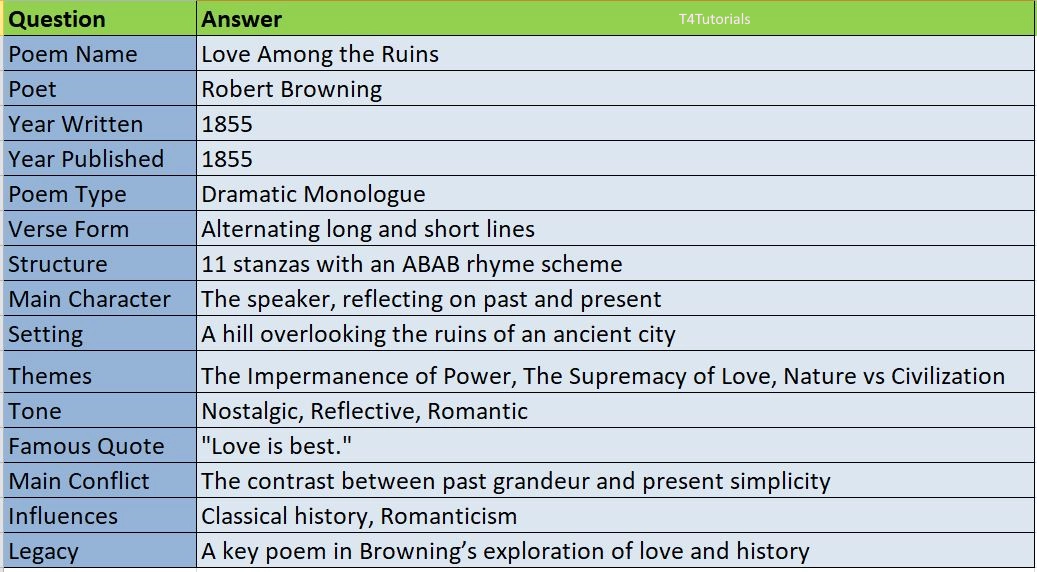
1. : What is the primary contrast in “Love Among the Ruins”?
(A) Love and war
(B) Wealth and poverty
(C) Nature and technology
(D) Past and future
2. : What does the speaker describe as having once stood where the ruins now lie?
(A) A vast and powerful empire
(B) A peaceful countryside
(C) A bustling marketplace
(D) A temple to the gods
3. : What poetic form is used in “Love Among the Ruins”?
(A) Sonnet
(B) Rhymed couplets
(C) Alternating long and short lines
(D) Free verse
4. : What does the speaker value more than the fallen civilization?
(A) Knowledge
(B) Love
(C) Power
(D) Nature
5. : What natural imagery is used to contrast with the ruins?
(A) Fields and flowers
(B) Oceans and waves
(C) Snow and ice
(D) Mountains and valleys
6. : What does the poem suggest about military conquests?
(A) They are the most important achievements
(B) They eventually fade into insignificance
(C) They are necessary for civilization
(D) They bring eternal fame
7. : How does the poem depict the ruins of the ancient city?
(A) As majestic and awe-inspiring
(B) As silent and desolate
(C) As still thriving
(D) As an inspiration for new construction
8. : What literary device is most prominent in the poem?
(A) Alliteration
(B) Juxtaposition
(C) Hyperbole
(D) Personification
9. : What is the tone of “Love Among the Ruins”?
(A) Nostalgic and reflective
(B) Angry and bitter
(C) Hopeful and cheerful
(D) Cynical and sarcastic
10. : What is the central message of the poem?
(A) War and power are the most important aspects of history
(B) Love is more enduring than worldly achievements
(C) The past is always better than the present
(D) Civilization is doomed to destruction