
Summary:
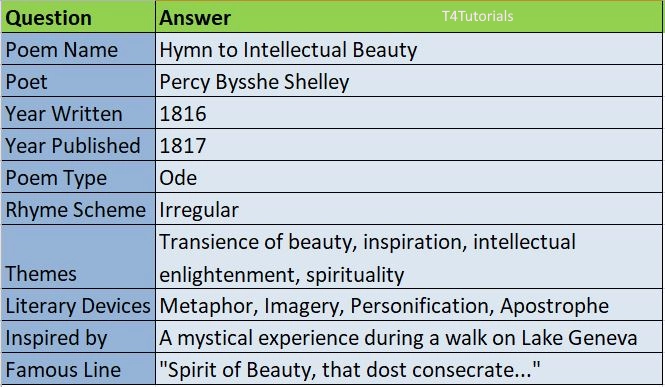
Hymn to Intellectual Beauty is an ode by Percy Bysshe Shelley that explores the mysterious and fleeting nature of beauty and inspiration. Shelley presents Intellectual Beauty as an unseen, supernatural force that moves through the world, bringing moments of enlightenment and artistic inspiration. However, this beauty is temporary and unpredictable, appearing and disappearing like a ghost or spirit.
Shelley recalls how, as a young boy, he longed to understand and possess this beauty permanently, but he soon realized that it cannot be controlled or summoned at will. He believes that true enlightenment and human progress come from embracing Intellectual Beauty rather than from organized religion or traditional beliefs. The poem expresses Shelley’s deep admiration for the power of the mind and imagination, and his desire to remain connected to this source of inspiration.
The poem is deeply philosophical, questioning the nature of human existence and our ability to perceive truth and beauty. Through rich imagery and metaphors, Shelley conveys the idea that Intellectual Beauty is essential for personal growth and the advancement of humanity.
1. : Who wrote Hymn to Intellectual Beauty?
(A) Lord Byron
(B) William Wordsworth
(C) Percy Bysshe Shelley
(D) John Keats
2. : What is the central theme of Hymn to Intellectual Beauty?
(A) The power of religious faith
(B) The fleeting nature of beauty and inspiration
(C) The importance of material wealth
(D) The role of monarchy in society
3. : Which poetic form is Hymn to Intellectual Beauty written in?
(A) Sonnet
(B) Ode
(C) Elegy
(D) Epic
4. : What does Shelley describe as “Intellectual Beauty” in the poem?
(A) The beauty of physical appearance
(B) The divine and mysterious power of inspiration
(C) The wealth of knowledge in books
(D) The structure of the universe
5. : How does Shelley describe the presence of Intellectual Beauty?
(A) As permanent and unchanging
(B) As something that comes and goes like a ghost
(C) As something controlled by the government
(D) As something irrelevant to human life
6. : Which literary device is frequently used in the poem?
(A) Metaphor
(B) Irony
(C) Satire
(D) Hyperbole
7. : What is the tone of Hymn to Intellectual Beauty?
(A) Humorous and lighthearted
(B) Reflective and reverent
(C) Angry and resentful
(D) Sarcastic and mocking
8. : What event in Shelley’s life inspired Hymn to Intellectual Beauty?
(A) His exile from England
(B) His experience of a sudden sense of enlightenment during a walk
(C) His imprisonment
(D) His discovery of a lost manuscript
9. : What does Shelley compare Intellectual Beauty to?
(A) The changing of the seasons
(B) The moon and stars
(C) A spirit or phantom
(D) The growth of a tree
10. : What does Shelley wish for in the poem?
(A) That Intellectual Beauty would remain with him forever
(B) That he could become rich and famous
(C) That he could return to his childhood
(D) That he could rule a kingdom