
Summary:
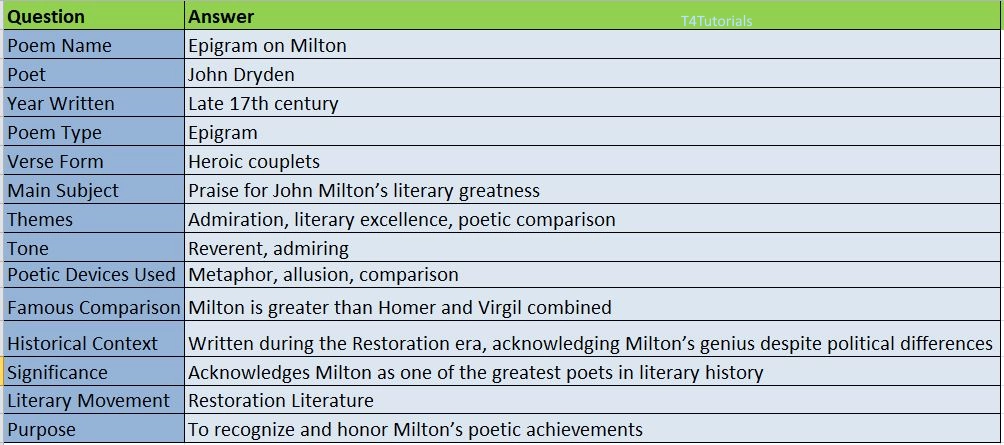
John Dryden’s Epigram on Milton is a brief yet powerful tribute to John Milton, recognizing his literary greatness. In this short poem, Dryden praises Milton as a poet of unmatched skill and compares him to the great epic poets of history. He famously states that Milton combines the strengths of Homer and Virgil, suggesting that Milton surpasses them both in poetic genius. The poem acknowledges Paradise Lost as a monumental work in English literature and affirms Milton’s place as one of the greatest poets of all time.
1. : Who is the subject of Dryden’s Epigram on Milton?
(A) William Shakespeare
(B) Geoffrey Chaucer
(C) John Milton
(D) Alexander Pope
2. : Which two classical poets does Dryden compare Milton to?
(A) Horace and Ovid
(B) Homer and Virgil
(C) Dante and Petrarch
(D) Chaucer and Spenser
3. : What is the primary theme of the poem?
(A) Political satire
(B) Admiration for Milton’s literary genius
(C) Criticism of contemporary poets
(D) Mourning the death of Milton
4. : Which of Milton’s works is implicitly referenced in the epigram?
(A) Samson Agonistes
(B) Paradise Lost
(C) Areopagitica
(D) Paradise Regained
5. : What poetic form does Dryden use in Epigram on Milton?
(A) Blank verse
(B) Heroic couplets
(C) Sonnet
(D) Free verse
6. : What does Dryden imply about Milton’s poetic ability?
(A) That he is an average poet
(B) That he surpasses both Homer and Virgil
(C) That he is too complex for readers
(D) That he lacks originality
7. : How does Dryden describe Milton’s literary contribution?
(A) As inferior to classical poets
(B) As revolutionary and unparalleled
(C) As outdated and unimportant
(D) As controversial and ineffective
8. : Which literary movement does Epigram on Milton belong to?
(A) Romanticism
(B) Restoration Literature
(C) Modernism
(D) Renaissance Poetry
9. : What is the tone of the poem?
(A) Satirical
(B) Reverent and admiring
(C) Humorous
(D) Tragic
10. : What famous line from the epigram summarizes Dryden’s praise of Milton?
(A) “Three poets in three distant ages born…”
(B) “Ode to thee, the greatest bard…”
(C) “Milton, thou shouldst be living at this hour…”
(D) “A poet above all, standing in his own time…”