
Summary:
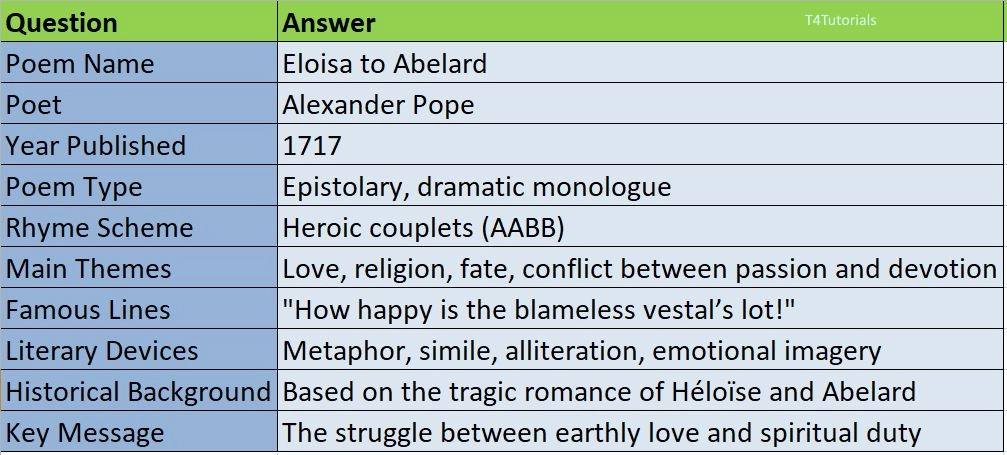
Eloisa to Abelard by Alexander Pope is an epistolary poem that explores the tragic love story between Héloïse (Eloisa) and Peter Abelard, two historical figures from 12th-century France. Written as a dramatic monologue, the poem captures Eloisa’s inner turmoil as she struggles between her passionate love for Abelard and her religious devotion. The poem is deeply emotional, filled with longing, guilt, and philosophical reflection on love, fate, and divine will. Pope’s use of heroic couplets enhances the lyrical and expressive nature of the poem, making it one of his most poignant works.
1. : Who wrote Eloisa to Abelard?
(A) John Milton
(B) Alexander Pope
(C) Geoffrey Chaucer
(D) William Wordsworth
2. : What is the poetic form of Eloisa to Abelard?
(A) Sonnet
(B) Blank verse
(C) Heroic couplets
(D) Free verse
3. : What is the primary theme of the poem?
(A) The power of nature
(B) The conflict between love and religious duty
(C) Political rebellion
(D) The pursuit of wealth
4. : Who is Eloisa addressing in the poem?
(A) God
(B) Her brother
(C) Abelard
(D) A fellow nun
5. : What historical event inspired Eloisa to Abelard?
(A) The execution of Anne Boleyn
(B) The love affair between Héloïse and Abelard
(C) The signing of the Magna Carta
(D) The Crusades
6. : What is Eloisa’s internal conflict in the poem?
(A) Choosing between wealth and poverty
(B) Struggling between passionate love and religious devotion
(C) Deciding whether to leave the convent
(D) Seeking revenge on Abelard
7. : How did Abelard and Eloisa’s love story end in real life?
(A) They got married and lived happily together
(B) Abelard was executed, and Eloisa became queen
(C) Abelard was castrated, and Eloisa became a nun
(D) They fled to another country and had children
8. : What literary devices are prominently used in the poem?
(A) Simile and metaphor
(B) Irony and satire
(C) Paradox and allegory
(D) Alliteration and assonance
9. : Which of the following lines is from Eloisa to Abelard?
(A) “To err is human, to forgive divine.”
(B) “How happy is the blameless vestal’s lot!”
(C) “A little learning is a dangerous thing.”
(D) “Hope springs eternal in the human breast.”
10. : What does Eloisa ultimately seek at the end of the poem?
(A) A reunion with Abelard in the afterlife
(B) Revenge on those who separated them
(C) A new romantic partner
(D) To escape the convent and find Abelard