
Summary:
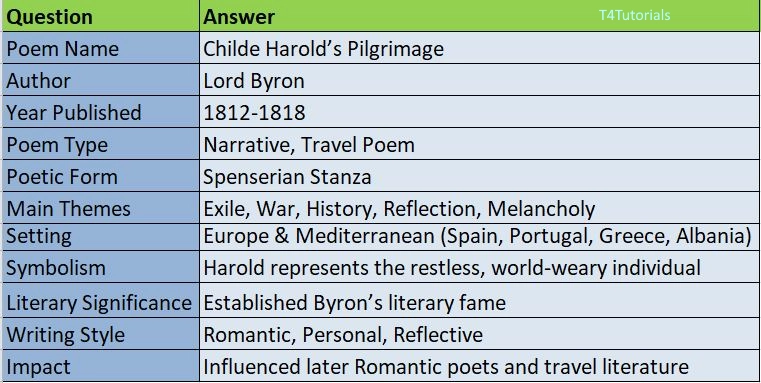
Childe Harold’s Pilgrimage is a lengthy narrative poem by Lord Byron, published between 1812 and 1818. It follows the travels and reflections of Childe Harold, a disillusioned young nobleman who embarks on a journey across Europe and the Mediterranean. The poem is deeply autobiographical, reflecting Byron’s own experiences and emotions.
Through Harold’s travels in Portugal, Spain, Greece, and Albania, Byron explores themes of war, exile, history, and the decline of great civilizations. The poem is written in Spenserian stanzas and is known for its Romantic themes of melancholy, admiration for nature, and critiques of political and societal corruption. The work established Byron’s fame as a major poet and is considered one of his greatest achievements.
1. : What is the main theme of Childe Harold’s Pilgrimage?
(A) Romantic love
(B) Political revolution
(C) Travel, exile, and reflection
(D) Religious devotion
2. : Who is the protagonist of the poem?
(A) Manfred
(B) Don Juan
(C) Childe Harold
(D) The Corsair
3. : What poetic form is used in Childe Harold’s Pilgrimage?
(A) Heroic couplets
(B) Spenserian stanzas
(C) Free verse
(D) Blank verse
4. : Which country is NOT visited by Childe Harold in the poem?
(A) Spain
(B) France
(C) Greece
(D) Portugal
5. : What personal experiences influenced Byron to write Childe Harold’s Pilgrimage?
(A) His political career
(B) His military service
(C) His European travels
(D) His studies at Cambridge
6. : In which year was the first part of the poem published?
(A) 1805
(B) 1812
(C) 1820
(D) 1831
7. : What emotion best describes Childe Harold’s outlook on life?
(A) Joyful optimism
(B) Melancholic disillusionment
(C) Angry rebellion
(D) Religious devotion
8. : Which historical event is referenced in the poem?
(A) The American Revolution
(B) The Napoleonic Wars
(C) The French Revolution
(D) The War of the Roses
9. : What impact did Childe Harold’s Pilgrimage have on Lord Byron’s career?
(A) It made him unpopular
(B) It had little effect
(C) It established him as a major poet
(D) It was criticized and ignored
10. : What does Byron critique in the poem?
(A) The power of nature
(B) The decay of civilizations
(C) The beauty of love
(D) The benefits of war