
Summary:
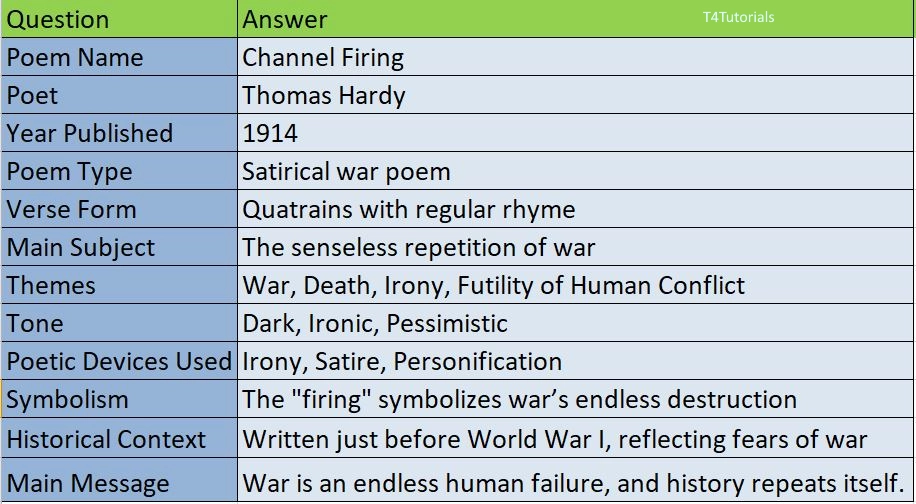
Thomas Hardy’s Channel Firing is a somber and ironic poem that reflects on the futility of war. Written in 1914, just before World War I, the poem presents a conversation between the dead in their graves and God. The loud sound of naval gunfire wakes the dead, making them think Judgment Day has arrived. However, God reassures them that it is not the end of the world—only humans preparing for another war. The poem critiques the endless cycle of conflict and mankind’s failure to learn from history. Hardy’s tone is darkly humorous, with God appearing weary of human violence, emphasizing the senseless destruction caused by war.
1. : Who wrote Channel Firing?
(A) T.S. Eliot
(B) Wilfred Owen
(C) Thomas Hardy
(D) W.B. Yeats
2. : When was Channel Firing written?
(A) 1890
(B) 1901
(C) 1914
(D) 1923
3. : What wakes the dead in the poem?
(A) An earthquake
(B) The sound of gunfire
(C) The voice of God
(D) The cries of soldiers
4. : What do the dead initially believe is happening?
(A) Judgment Day
(B) The start of a new war
(C) A great storm
(D) The end of suffering
5. : Who speaks to the dead in the poem?
(A) The devil
(B) A general
(C) God
(D) A ghostly soldier
6. : What does God tell the dead?
(A) That Judgment Day is near
(B) That war is starting again
(C) That the world has learned from past mistakes
(D) That peace has finally arrived
7. : What is the main theme of Channel Firing?
(A) The horrors of war and its endless cycle
(B) The beauty of nature
(C) The power of the church
(D) The heroism of soldiers
8. : What is ironic about God’s words in the poem?
(A) He is angry at humanity for waging war
(B) He suggests Judgment Day would be no different from normal human warfare
(C) He encourages the dead to rise and fight
(D) He praises human progress
9. : How does Hardy portray war in the poem?
(A) As a noble and heroic act
(B) As an endless, meaningless cycle
(C) As a temporary problem
(D) As a necessary evil
10. : What tone does Hardy use in the poem?
(A) Joyful and celebratory
(B) Dark and ironic
(C) Neutral and factual
(D) Hopeful and optimistic
11. : Which literary device is used in the line “Till God called, ‘No; it’s gunnery practice out at sea’”?
(A) Simile
(B) Personification
(C) Irony
(D) Hyperbole
12. : What historical event does the poem anticipate?
(A) The American Civil War
(B) World War I
(C) The Napoleonic Wars
(D) The French Revolution
13. : What does Hardy suggest about human nature in the poem?
(A) Humans are doomed to repeat their mistakes
(B) Humans always strive for peace
(C) War is justified in certain cases
(D) God controls all human actions
14. : Why do the dead return to their graves at the end of the poem?
(A) They are afraid of war
(B) They realize war will never end
(C) God commands them to stay buried
(D) They are waiting for Judgment Day
15. : Which literary technique does Hardy use frequently in the poem?
(A) Satire
(B) Romantic imagery
(C) Dramatic monologue
(D) Heroic couplets