
Summary:
An Essay on Man by Alexander Pope is a philosophical poem that explores humanity’s role in the universe, emphasizing the idea that everything happens according to God’s divine plan. Written in heroic couplets, the poem seeks to “vindicate the ways of God to man” by urging people to accept their position in the grand order of creation. Pope argues that humans should not question God’s will but instead recognize their limitations and trust in divine wisdom. The poem is divided into four epistles, each discussing a different aspect of human existence, such as man’s relationship with the universe, himself, society, and happiness.
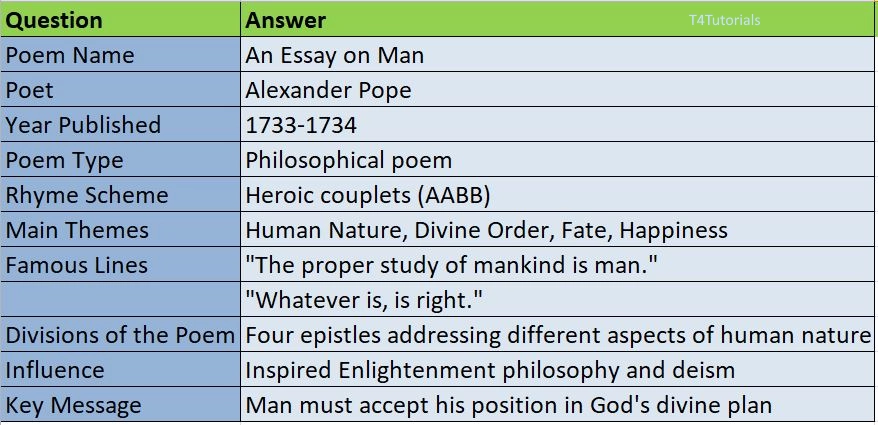 An Essay on Man
1. : Who is the poet of An Essay on Man?
(A) John Dryden
(B) Alexander Pope
(C) William Blake
(D) John Milton
2. : What is the main purpose of An Essay on Man?
(A) To discuss the beauty of nature
(B) To explain the divine order of the universe
(C) To criticize political leaders
(D) To argue against religion
3. : In which poetic form is An Essay on Man written?
(A) Blank verse
(B) Free verse
(C) Heroic couplets
(D) Sonnet
4. : Which philosophy influences the poem?
(A) Romanticism
(B) Neoclassicism
(C) Existentialism
(D) Postmodernism
5. : What is the famous line from the poem?
(A) “To err is human, to forgive divine.”
(B) “A little learning is a dangerous thing.”
(C) “The proper study of mankind is man.”
(D) “I think, therefore I am.”
6. : How many epistles are in An Essay on Man?
(A) Two
(B) Three
(C) Four
(D) Five
7. : What does Pope argue is the key to human happiness?
(A) Power and wealth
(B) Questioning God’s plan
(C) Accepting one’s place in the universe
(D) Seeking revenge
8. : What is the theme of the first epistle?
(A) The human struggle for power
(B) The role of government
(C) The limitations of human knowledge
(D) The importance of art
9. : What does Pope suggest about human pride?
(A) It is necessary for progress
(B) It leads to ignorance and suffering
(C) It has no effect on human life
(D) It is a divine quality
10. : What is the central message of An Essay on Man?
(A) Man is superior to all creation
(B) Man must accept his role in God’s plan
(C) Man can control his own destiny
(D) Nature is meaningless