
1. Who is the central focus of Spenser’s Amoretti?
(A) His muse, Elizabeth Boyle
(B) A mythological figure
(C) A historical king
(D) A fictional lady
2. What is the main theme of Amoretti?
(A) Political conflict
(B) The poet’s love and admiration for Elizabeth Boyle
(C) Nature and the seasons
(D) Religion and morality
3. What literary device is prominently used in Amoretti?
(A) Allegory
(B) Satire
(C) Sonnet form with rhyme and rhythm
(D) Epic narrative
4. How does Spenser portray his beloved in the sonnets?
(A) Flawed and ordinary
(B) Powerful and authoritative
(C) Indifferent and cruel
(D) Admired for her beauty, virtue, and grace
5. What is a recurring symbol in Amoretti?
(A) War and conquest
(B) Money and wealth
(C) Flowers and nature representing love and purity
(D) The city
6. How does Spenser often express the passage of time?
(A) Through historical events
(B) Through nature imagery and changing seasons
(C) Through political commentary
(D) Through dialogue
7. What does Spenser hope for in his love poems?
(A) Eternal love and spiritual union with Elizabeth Boyle
(B) To win wealth and status
(C) To travel the world
(D) To gain political influence
8. How is Spenser’s tone throughout Amoretti?
(A) Lighthearted and humorous
(B) Romantic, admiring, and devotional
(C) Angry and confrontational
(D) Philosophical and abstract
9. Which of the following best describes the structure of Amoretti?
(A) A series of epic narratives
(B) A single continuous poem
(C) A sequence of 89 sonnets
(D) A play in verse
10. How does Amoretti reflect Renaissance ideals?
(A) Through its focus on war and conquest
(B) Through criticism of the monarchy
(C) Through exploration of scientific ideas
(D) Through the celebration of human love, beauty, and virtue
11. What is the central theme of Amoretti?
(A) Political corruption
(B) Love, patience, and beauty
(C) The quest for knowledge
(D) The struggle for power
12. How many sonnets are in the Amoretti sequence?
(A) 54
(B) 100
(C) 89
(D) 72
13. To whom is Amoretti dedicated?
(A) The Queen of England
(B) Elizabeth Boyle, Spenser’s wife
(C) The Earl of Leicester
(D) Sir Walter Raleigh
14. What poetic form does Spenser use in Amoretti?
(A) Haiku
(B) Shakespearean sonnet
(C) Petrarchan sonnet
(D) Spenserian sonnet
15. What is the speaker’s primary emotion in the early sonnets of Amoretti?
(A) Anger
(B) Longing and unrequited love
(C) Joy and happiness
(D) Indifference
16. What does the speaker ultimately achieve in Amoretti?
(A) Fame and glory
(B) Wealth and power
(C) Mutual love and marriage with Elizabeth Boyle
(D) Success in a political career
17. What literary device is prominent in Amoretti?
(A) Allegory
(B) Irony
(C) Alliteration
(D) Hyperbole
18. In Amoretti, what is Spenser’s attitude toward love?
(A) Cynical and disillusioned
(B) Dispassionate and indifferent
(C) Optimistic and patient
(D) Fearful and hesitant
19. What role does Elizabeth Boyle play in Amoretti?
(A) She is a symbol of political power
(B) She is the object of the speaker’s affection
(C) She is a muse for artistic creation
(D) She represents unrequited love
20. How does Amoretti end?
(A) With the speaker and Elizabeth Boyle’s marriage
(B) With the speaker’s confession of lost hope
(C) With the speaker declaring his love for another woman
(D) With the speaker’s rejection by Elizabeth Boyle
Summary:
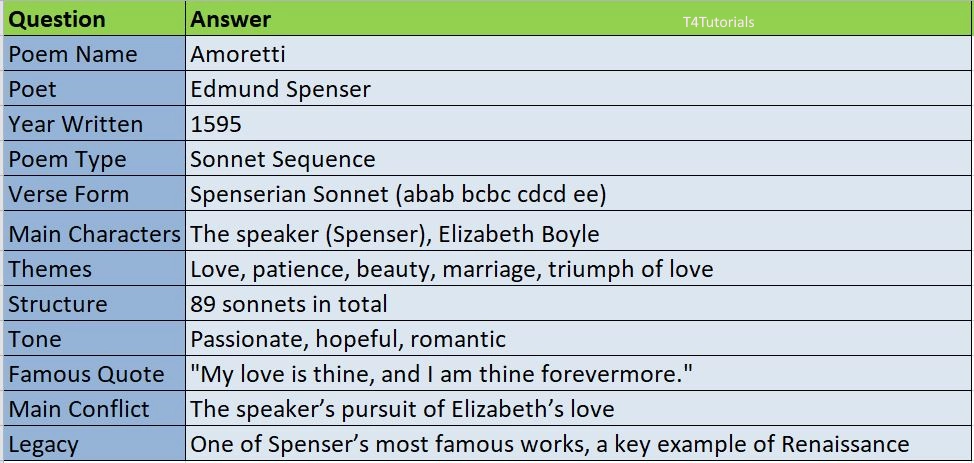
Amoretti is a sonnet sequence written by Edmund Spenser. It consists of 89 sonnets, written in the traditional Petrarchan style, and it details Spenser’s courtship and eventual marriage to his beloved, Elizabeth Boyle. The sequence captures Spenser’s intense love for Elizabeth, his deep admiration for her beauty, and his yearning for her affection. Throughout the poems, the speaker struggles with his feelings of unrequited love, but he also expresses hope and optimism as he believes that his sincere love will eventually win her over. The sonnets evolve from expressions of longing and passion to the eventual declaration of mutual love and marriage.
The central themes of Amoretti include love, beauty, patience, and the triumph of love over adversity. The sequence begins with the speaker’s internal conflict over whether Elizabeth will return his love, but gradually moves towards a celebration of love’s transformative power, culminating in their marriage. The sonnet sequence is also notable for its use of rich, sensuous language, and it demonstrates Spenser’s mastery of the sonnet form. In addition, Amoretti can be seen as an allegory of the poet’s personal growth in his pursuit of love and his journey toward finding fulfillment.
1. : What is the central theme of Amoretti?
(A) Political corruption
(B) Love, patience, and beauty
(C) The quest for knowledge
(D) The struggle for power
2. : How many sonnets are in the Amoretti sequence?
(A) 54
(B) 100
(C) 89
(D) 72
3. : To whom is Amoretti dedicated?
(A) The Queen of England
(B) Elizabeth Boyle, Spenser’s wife
(C) The Earl of Leicester
(D) Sir Walter Raleigh
4. : What poetic form does Spenser use in Amoretti?
(A) Haiku
(B) Shakespearean sonnet
(C) Petrarchan sonnet
(D) Spenserian sonnet
5. : What is the speaker’s primary emotion in the early sonnets of Amoretti?
(A) Anger
(B) Longing and unrequited love
(C) Joy and happiness
(D) Indifference
6. : What does the speaker ultimately achieve in Amoretti?
(A) Fame and glory
(B) Wealth and power
(C) Mutual love and marriage with Elizabeth Boyle
(D) Success in a political career
7. : What literary device is prominent in Amoretti?
(A) Allegory
(B) Irony
(C) Alliteration
(D) Hyperbole
8. : In Amoretti, what is Spenser’s attitude toward love?
(A) Cynical and disillusioned
(B) Dispassionate and indifferent
(C) Optimistic and patient
(D) Fearful and hesitant
9. : What role does Elizabeth Boyle play in Amoretti?
(A) She is a symbol of political power
(B) She is the object of the speaker’s affection
(C) She is a muse for artistic creation
(D) She represents unrequited love
10. : How does Amoretti end?
(A) With the speaker declaring his love for another woman
(B) With the speaker’s confession of lost hope
(C) With the speaker and Elizabeth Boyle’s marriage
(D) With the speaker’s rejection by Elizabeth Boyle