
1. Who composed the music that inspires “A Toccata of Galuppi’s”?
(A) Ludwig van Beethoven
(B) Baldassare Galuppi
(C) Wolfgang Amadeus Mozart
(D) Johann Sebastian Bach
2. What is a toccata?
(A) A form of dance
(B) A philosophical concept
(C) A type of musical composition
(D) A historical event
3. What city does the speaker reflect on while listening to the toccata?
(A) Rome
(B) London
(C) Paris
(D) Venice
4. What theme is central to the poem?
(A) The power of love
(B) The fleeting nature of life and pleasure
(C) The beauty of nature
(D) The importance of war
5. How does the speaker feel about the past as he listens to the music?
(A) Completely joyful
(B) Indifferent
(C) Melancholic and reflective
(D) Enraged
6. What does the poem suggest about the Venetian society of Galuppi’s time?
(A) It was deeply religious
(B) It was isolated from the rest of the world
(C) It was engaged in constant warfare
(D) It was full of pleasure-seekers who ignored mortality
7. What literary device is used when the speaker imagines the past through the music?
(A) Hyperbole
(B) Alliteration
(C) Imagery and personification
(D) Simile
8. How does the speaker contrast the past and present?
(A) The past was filled with joy and carefreeness, while the present is somber and reflective
(B) The past was dull, and the present is exciting
(C) The past was a time of war, and the present is peaceful
(D) The past was religious, and the present is secular
9. What is the tone of the poem?
(A) Cheerful and celebratory
(B) Reflective and melancholic
(C) Angry and bitter
(D) Hopeful and optimistic
10. What message does the poem convey about art and music?
(A) Music has no impact on emotions
(B) Art and music preserve history and evoke deep reflection
(C) Only modern music is meaningful
(D) Art and music are distractions from reality
Summary:
“A Toccata of Galuppi’s” is a reflective poem by Robert Browning, published in 1855 as part of Men and Women. The poem revolves around the speaker listening to a toccata (a type of musical composition) by Baldassare Galuppi, an 18th-century Venetian composer. As the speaker imagines the past, he envisions the lively, pleasure-seeking society of Venice, where people danced and enjoyed themselves under Galuppi’s music. However, beneath this joy lies a sense of melancholy, as the poem contemplates the fleeting nature of pleasure, mortality, and the contrast between past and present. Through a blend of historical reflection and philosophical musing, Browning highlights themes of impermanence, the passage of time, and the power of music to evoke deep emotions.
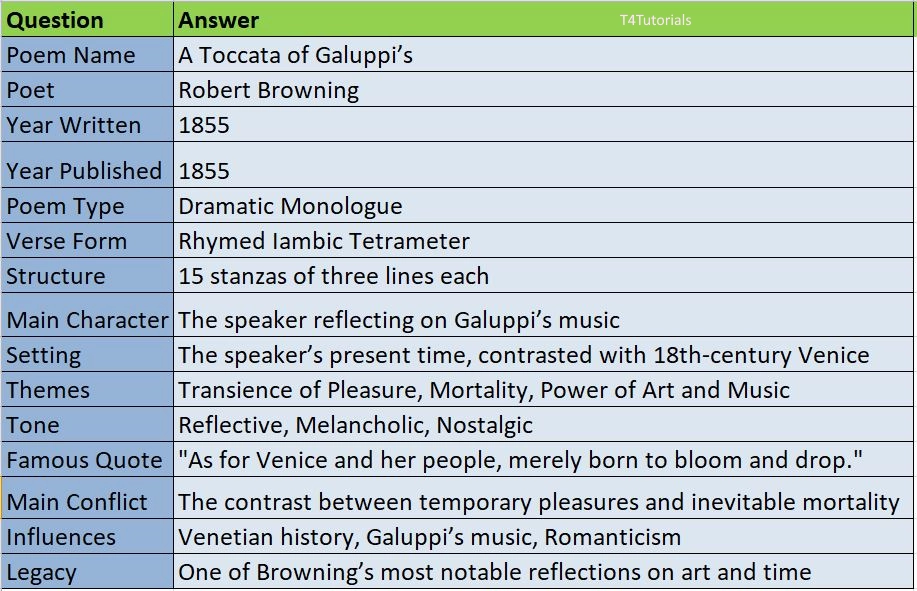
| Question | Answer |
| Poem Name | A Toccata of Galuppi’s |
| Poet | Robert Browning |
| Year Written | 1855 |
| Year Published | 1855 |
| Poem Type | Dramatic Monologue |
| Verse Form | Rhymed Iambic Tetrameter |
| Structure | 15 stanzas of three lines each |
| Main Character | The speaker reflecting on Galuppi’s music |
| Setting | The speaker’s present time, contrasted with 18th-century Venice |
| Themes | Transience of Pleasure, Mortality, Power of Art and Music |
| Tone | Reflective, Melancholic, Nostalgic |
| Famous Quote | “As for Venice and her people, merely born to bloom and drop.” |
| Main Conflict | The contrast between temporary pleasures and inevitable mortality |
| Influences | Venetian history, Galuppi’s music, Romanticism |
| Legacy | One of Browning’s most notable reflections on art and time |